Wiring the Monitoring-to-Merge Pipeline so Every Shipped Fix Earns Its Next Signal
A merged fix proves little unless monitoring can show it held.
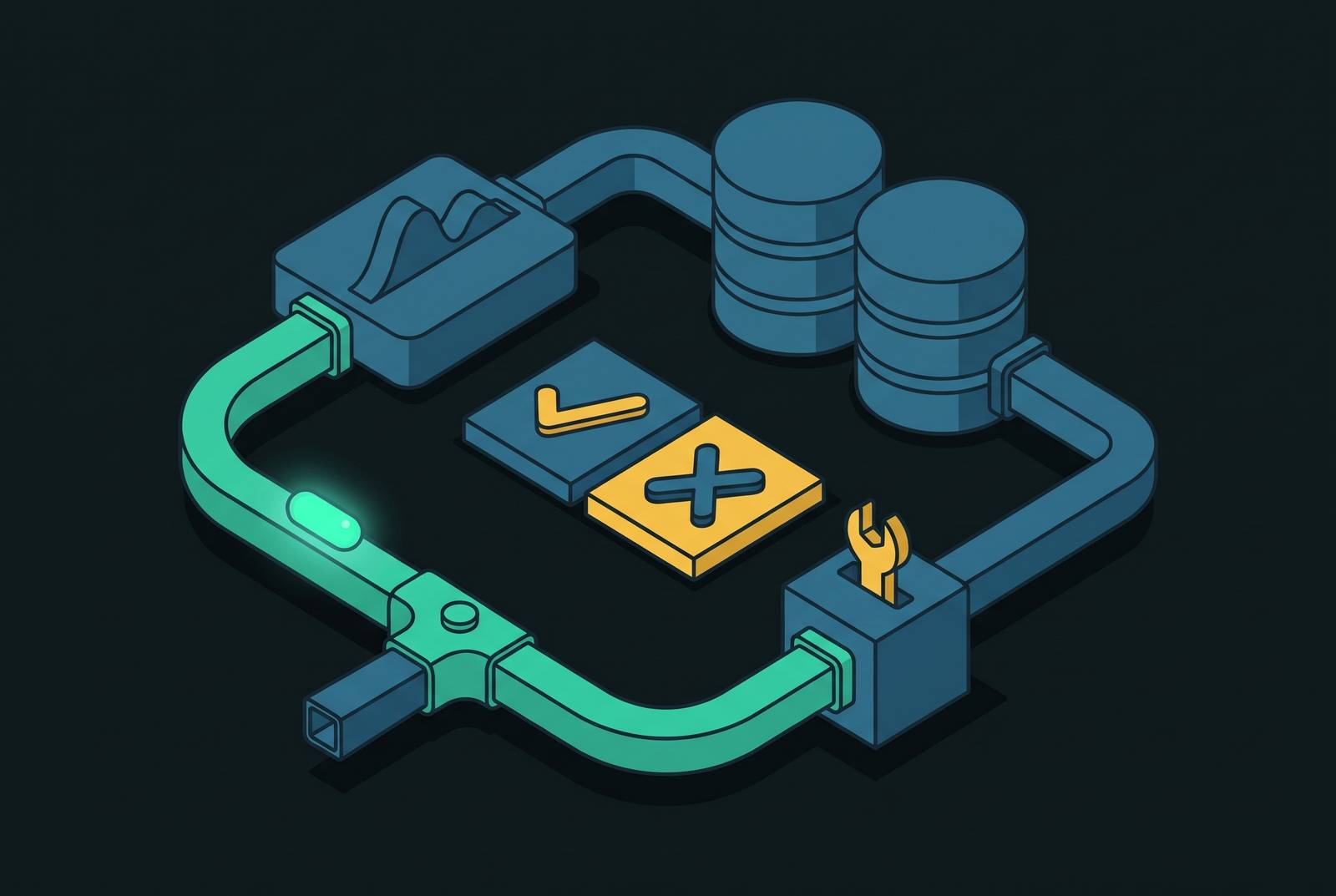
A monitoring-to-merge pipeline turns production agent traces into continuous improvement only when every shipped fix generates the evidence needed to judge whether it held. Teams must attribute the failure, validate a targeted repair through replay, and attach persistent monitoring to the changed harness layer.
Why the monitoring-to-merge pipeline breaks after the fix ships
Treating merge as the endpoint leaves the pipeline’s final dependency unresolved. Its three stages, observe, diagnose, and validate, can produce a defensible repair without establishing how production will reveal its recurrence. A merged change is not that evidence. Unless monitoring is tied to the behavior the fix changed, the next failure arrives without a clear connection to the earlier diagnosis.
Scale AI’s Continual Search paper identifies root-cause attribution as the feedback layer between failed executions and continual improvement. Outcome-level signals indicate that an execution failed but provide little guidance about where to intervene. That limitation survives deployment when the repaired behavior has no dedicated detector. An aggregate error rate may show another failure, but it does not establish whether the previous repair held, shifted the failure elsewhere, or missed its cause. The missing connection is between the diagnosis behind the change and the evidence collected after it.
Why localizing the failure that the fix was meant to address is harder than it looks
Failure localization is a search problem. Evidence is often sparse, spread across distant steps, and separated from the visible symptom. In a failed web-search task, correlation-based attribution can blame the agent reporting “no results” rather than the upstream agent that formulated an overly restrictive query. The final error is easier to find than the decision that caused it.
Three recurring failure patterns deepen this ambiguity. Tool schema drift involves ambiguous schemas, weak parameter validation, and non-actionable errors that can end execution without a useful learning signal. AgentDebugX identifies prompt ambiguity around empty inputs, invalid formats, and other unspecified edge cases, including JSON parsing failures that survive schema-constrained prompting. Workflow loops create a different diagnostic problem. Repeated failed calls or stalled execution can resemble normal retries unless loop detection is explicitly instrumented.
LongRCA Bench shows how distance compounds that gap, with reference roots preceding task completion by a median of 48 recorded steps. Early mistakes persist while their explanatory evidence disperses. Continual Search finds that one-shot judges often settle on an explanation that sounds right before looking at key evidence in longer traces. The symptom, the origin, and the evidence needed to connect them may occupy different parts of the execution.
What telemetry must actually contain to support causal attribution rather than just detection
The first requirement is structural. TelemetrySuffBench finds that when decision content is removed, origin-step accuracy falls to zero for every model tested, while removing provenance causes large losses that vary by model. With terminal status alone, detection F1 can be nearly perfect even when origin localization is nearly impossible. Attribution needs decision content, identity, and provenance that links the decision to the upstream instruction or input behind it.
For a team auditing its traces, every model invocation must retain both its output and the input context that produced it. The trace must capture what the model chose and why. Every tool call must link to the decision step that issued it, so the call remains part of an explanatory sequence. Memory reads and writes must record the relevant state and the decision it influenced.
Inter-agent handoffs need the same continuity across agent boundaries. They must propagate the originating instruction so that a downstream failure can be traced to its source rather than assigned automatically to the receiving agent. Continual Search notes that the evidence needed in multi-agent systems is spread across agents that interact with one another. A trace that ends at a handoff breaks that evidence chain.
How iterative, evidence-driven attribution outperforms single-pass diagnosis on the traces that matter most
Continual Search introduces successive diagnostic turns that prompt the judge to keep searching for unresolved evidence. The approach improves attribution F1 on long-horizon traces and shows that lower-tier models using effective search can outperform higher-tier models making single-pass judgments. Search method changes what the judge can recover. LongRCA Bench’s RCTA method retrieves original candidate evidence and compares it with upstream instructions, raising exact root-step accuracy to nearly double the strongest single-pass baseline.
AgentDebugX’s DeepDebug combines global trajectory understanding, structure-guided investigation, and cross-examination. On Who&When, it achieves higher exact agent-and-step accuracy than the strongest single-pass baseline on both tested open-weight backbones. TRAJDEBUG helps clear up a related source of confusion by tracking error lifecycles across the trajectory. Some local errors are repaired, some are harmless, and only some contribute to terminal failure.
Diagnosis must be iterative and evidence-gated before a repair is proposed. Candidate explanations must be tested against upstream instructions, later resolution, and terminal impact rather than accepted because they fit the visible symptom. An inaccurate attribution can produce both the wrong fix and a precise detector for the wrong behavior, leaving the actual cause outside the next monitoring cycle.
Replay-based validation as the gate between a diagnosed fix and a merged one
Replay establishes the reference against which later production behavior can be judged. The validation gate begins with historical traces and unchanged agent code, using binary equivalence as its foundational criterion. Divergence under that condition signals a correctness issue, such as a control-flow fork, prompt drift, or an untraced dependency.
Once the baseline is established, the team makes one targeted change, reruns the relevant tasks, and rescores the results. Harness hill-climbing retains the change only if the score improves. Changing prompt wording and tool descriptions together conflates their effects and makes rollback ambiguous. AgentDebugX expresses the larger sequence as Detect, Attribute, Recover, and Rerun. Its rerun of 73 failed GAIA tasks after DeepDebug diagnosis repaired a materially larger fraction than three decoupled self-correction baselines.
The gate must examine drift as well as task recovery. Tool-call distributions show whether a planner has moved toward another tool, while structured-output schema conformance can show whether prompt ambiguity has returned. Cost and latency also belong in the comparison because reduced error rates can accompany token consumption that will not hold under production load. Rotating replay tasks to include out-of-distribution scenarios guards against eval overfitting. A repair should survive the broader failure class.
How do teams close the loop between agent monitoring and shipping better agents?
After the PR merges, the team must re-instrument the original failure signal around the changed harness layer. First, attach span-level evaluation scores to that layer. If the repair narrowed a tool schema, schema-conformance scores on that tool’s spans become the ongoing measure. The signal must follow the scope of the change.
Next, register the addressed failure pattern as a named, persistent detector in the trace pipeline. That registration makes recurrence visible in the trace pipeline as a regression linked to the addressed failure pattern. Then set a weekly schedule to check for drift in tool-call distribution and schema conformance in post-merge production traffic. Use the pre-merge replay baseline as the reference. The comparison must preserve the link between what validation established and what deployment now produces.
With that wiring in place, structured observations can support further harness responses. A failed tool call can trigger a memory write recording its context, repeated failures can flag a skill for revision, and a latency spike can cause a switch in protocol paths. The harness and its monitoring must therefore change in lockstep, so each repair produces evidence for the next decision rather than consuming the evidence from the last incident.
What the loop looks like in practice across the harness layers that fail most often
A repair for prompt ambiguity usually adds clear instructions for how to handle empty inputs, invalid formats, or ambiguous routing. Its post-merge signals are JSON parsing failure rate on the affected prompt’s output spans and schema-conformance rate on its structured outputs. Replay must include out-of-distribution inputs within the repaired edge-case class. By extending replay beyond the original failing input, this scope tests whether the added instruction handles the ambiguity across the repaired edge-case class.
A tool schema repair instead narrows the schema or strengthens argument validation. Its persistent signals are tool-call rejection rate and argument-validation failure rate on the repaired tool’s spans. Replay covers calls that ran into the ambiguous schema before, as well as calls that use adjacent tools. Those adjacent calls expose possible substitution drift. A planner’s movement away from the repaired tool would otherwise complicate the interpretation of fewer failures on that tool.
A workflow loop repair needs explicit loop annotations. Each iteration must map to reasoning, action, and observation spans, rather than being inferred from aggregate step counts. Post-merge monitoring then tracks the loop-iteration count for each episode and the goal-progress rate across runs. Fewer iterations do not establish success when progress stalls. TRAJDEBUG’s distinction between repaired, harmless, and critical errors applies here because a loop that terminates mid-run may suppress a symptom without reaching the upstream error.
Why harness iteration without systematic signal tracking reverts to guesswork
Informal iteration on prompts and tools can fix failures. Its limitation appears when the team needs to distinguish a local improvement from a regression elsewhere. A prompt rewrite can fix one failure mode while breaking another, and a tool addition can improve eval scores while degrading conversation quality. Repeated iterations can also overfit the held-out set. Without systematic signal tracking, the team must redo the attribution search by hand and has no reliable record of what each change did.
The harness-R1 work studies a dedicated harness engineer, an editing policy that is trained with online reinforcement learning while the target agent stays frozen. Keeping the actor stable while improving the meta-layer depends on capturing and attributing the signal from each change. Co-Harness uses a dual-loop approach in which HarnessCritic assigns failed trajectories to structured harness-level causes before generating a repair. Those causes include prompt ambiguity, tool schema error, missing skill, and middleware mismatch.
Cheaper changes do not justify weaker verification. Because harness edits are fast to ship, untracked regressions can accumulate through successive repairs before their interactions become clear. The answer is not to abandon informal iteration, but to retain its evidence and test its effects. That is what allows one iteration to inform the next without relying on a team member’s recollection of why a prompt or tool description changed.
Building the pipeline as an engineering discipline, with repeatability, reviewability, and rollback
A repeatable pipeline requires attribution, validation, merge, and signal registration to be as auditable as code review. Every root-cause claim must come with both a verdict and the evidence chain that led to it. Reviewers need that chain to challenge the repair before shipment and calibrate its detector against the same evidence afterward. AgentDebugX’s Error Hub provides a model through shareable trajectory–diagnosis–repair bundles. The failure becomes institutional memory rather than knowledge that disappears when the incident closes.
Reviewability also depends on keeping each iteration scoped to one variable, whether the change touches a prompt, tool schema, or workflow. That constraint makes score changes attributable and reversion unambiguous. Rollback must remain a practical part of the pipeline. If post-merge drift signals breach the threshold within the first week of production traffic, the team must be able to revert the harness change and rerun the original replay suite to establish that the reversion held.
A shipped change needs a registered detector, a baseline for interpreting its signal, and a tested route back if behavior degrades. Those records give the next investigation a place to start that the previous one did not have.
Sources
- Root-Cause Attribution Is a Search Problem: Continual Search for Long-Horizon Agent Failures
- TelemetrySuffBench: Is Agent Telemetry Sufficient for Failure-Origin Diagnosis?
- LongRCA Bench: Root-Cause Localization in Long-Horizon Agent Trajectories
- TRAJDEBUG: Tracing Error Lifecycle to Identify Critical Failures in Long-Horizon Agent Trajectories
- AgentDebugX: An Open-Source Toolkit for Failure Observability, Attribution, and Recovery in LLM Agents