Production Evidence Requirements for Promoting Memory Patterns and Retiring Mis-Routed Tool Calls
The article sets the trace evidence needed before changing an agent harness.

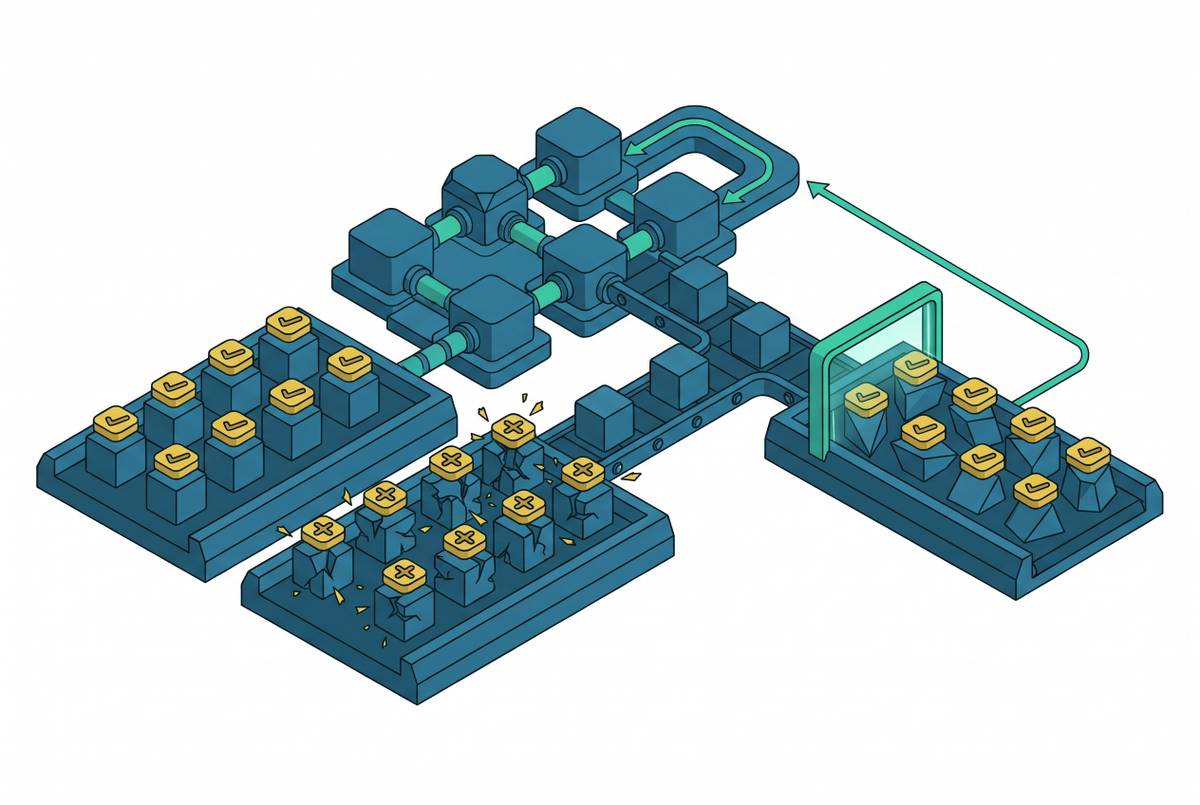
A production trace-driven harness engineering workflow collects decision-level traces, evaluates failures, groups recurring patterns, diagnoses their origins, tests changes, and uses post-deployment evidence to guide the next review. Promoting memory patterns and retiring mis-routed tool calls require the same foundation, namely reproducible attribution across production trajectories and validation against working behavior. A failed run starts an investigation. It does not justify a harness change.
Why promoting a memory pattern or retiring a tool call requires more than a failed run
The harness includes prompts, tools, workflow, and memory, and it is where most agent failures originate. Changes to those layers can fix real defects, but they can also disrupt behavior that already works. Without a defined evidence bar, the most recent failure can dominate the decision even when it does not represent the underlying pattern. Recency becomes a substitute for causal evidence.
AgentDebugX identifies the central difficulty as the separation between the step where an error surfaces and the step that caused it. Retiring the tool associated with the visible failure may leave the actual defect untouched while removing a capability that other workflows need. Similarly, promoting memory from a successful session may preserve a coincidental association. Both errors can silently break working behavior.
Why root-cause attribution in long agent runs is a search problem, not a single-pass inspection
Failure evidence in long agent runs is sparse and distributed across distant steps. An early mistake can persist through later actions that appear valid, so inspecting the final error does not explain how the trajectory went wrong. In LongRCA Bench, reference root causes come a median of 48 recorded steps before the task ends. More than a quarter of its trajectories contain a very large number of steps after the decisive error. The terminal event is therefore a poor starting assumption for attribution, even when it is an effective signal for detection.
TelemetrySuffBench demonstrates how sharply those tasks can diverge. A terminal status can expose failure without preserving its cause. The distinction is operationally important because an alert may be reliable while the diagnosis built from the same data is not.
Scale AI’s Continual Search paper frames attribution as testing competing explanations and discarding them when contradictory evidence appears. One-shot judgments instead tend to settle on an early plausible diagnosis, leaving relevant portions of longer traces unexamined. That is a failure of both search and reading. For practitioners, the implication is that trajectory-level analysis must revisit evidence as the explanation develops. A locally convincing account does not meet the standard if distant decisions could contradict it.
The three failure categories most likely to produce a wrong harness verdict
Tool call failures often occur when parameters are malformed, invalid, or incorrect, but the rejection does not show which layer has the defect. Schema drift makes this especially difficult. When a field is renamed or a validator becomes stricter, the schema can still look valid as execution goes on and completion rates drop days later. The symptom can resemble a model capability limit or an ambiguous prompt. Retiring the call on that basis confuses a versioned-contract problem with a routing problem.
Prompt ambiguity produces a different attribution trap because there may be no clear reference for what the instruction was supposed to mean. A defect in the prompt can then make an agent’s interpretation look like a capability failure. A model upgrade does not address that defect. Neither does retiring a tool call or adjusting routing when the instruction itself is unclear.
Workflow loops can also lead investigators to the wrong layer when stale long-term memory makes an agent seem off-task or a task seem unusually complex. A pattern that resolves the loop in one session may appear ready for promotion even though it introduces stale-context failures elsewhere. Memory scope becomes essential to interpreting that success. TRAJDEBUG adds that failed trajectories often have several local errors, including mistakes that were repaired and symptoms that appeared downstream. The critical error is therefore neither necessarily the first mistake nor the one nearest the terminal failure.
What telemetry must capture before any harness verdict is reliable
A usable trace covers every LLM call, tool invocation, retrieval step, and memory read while preserving decision content and explicit decision-to-provenance links. Exported spans must not strip those fields away. TelemetrySuffBench finds that removing decision content collapses origin-step accuracy to zero across every model tested, while removing provenance causes additional large losses. These fields support different parts of the causal account, including what decision occurred and which prior evidence informed it.
Tool and memory records need further specificity because their failure modes depend on information that generic outcomes omit. Tool records must retain the actual arguments and allow comparison with the versioned schema in effect at call time. Memory records must show which reads are short-term and which are long-term. Without that scope, a stale-memory loop can remain indistinguishable from a planning error. Without argument-level capture, a rejected call cannot reliably be separated into schema drift, malformed input, or an incorrect routing decision.
AgentDebugX has a portable trajectory format for re-analysis across frameworks, so multi-agent workflows can be investigated without being tied to vendor-specific span representations. Portability does not resolve missing evidence, however. The attribution system must be able to abstain when the trace cannot support a unique origin. The telemetry benchmark finds that evidence gating reduces unsupported answers for some models, while two models still answer every ambiguous case, so safe abstention cannot be assumed from the model alone.
The attribution method must match the trajectory length and failure type
For long trajectories, the method must search beyond the first plausible explanation and examine evidence that could overturn it. AgentDebugX’s DeepDebug reaches 28.8% exact agent-and-step attribution accuracy on the Who&When benchmark, substantially outperforming the strongest single-pass baseline with an open-weight backbone at a modest parameter count. That result makes search strategy a substantive part of the evidence standard. A larger judge does not remove the need for investigation.
Continual Search improves F1 materially on MegaRCA-Mix through a methodological requirement for the judge to challenge its standing answer at successive turns. LongRCA Bench’s RCTA method separates activity tied to a failure from the step where the decisive error began. Checking candidate evidence against upstream instructions helps show whether an error was inherited or first arose during execution.
With cascading failures, an error can occur without playing a part in the final outcome. TRAJDEBUG’s lifecycle tracing separates error trigger detection, error state classification, and critical attribution so that intermediate repairs affect the diagnosis. Resolution status changes the causal account. A method that finds mistakes without checking how they affected the final outcome can still choose the wrong thing to repair. For a team reviewing a 100-step trajectory, a single-pass judgment does not meet the bar merely because it had access to the entire trace.
The concrete evidence bar for retiring a mis-routed tool call
Before retirement, trajectory-level attribution must show a reproducible pattern in which the same tool call is the decisive error source in multiple independent failed trajectories. Repetition of a visible symptom is not enough. The attribution must hold independently rather than depend on one failed run being treated as representative. This is the distinction between a routing hypothesis and a warranted harness decision. Output-level failure establishes the need to investigate, but not which call should disappear.
Alternative-cause elimination is a required part of that decision. The analysis must examine prompt ambiguity and workflow structure as competing explanations before treating the call as the root cause. Schema version pinning is equally necessary. The failing arguments must be assessed against the tool’s schema at call time, because a failure introduced by schema drift calls for schema maintenance. Repeated failures do not strengthen a routing verdict when they repeatedly arise from the wrong cause.
Even a sound attribution does not establish that retirement is safe. Before deployment, the change must pass a regression suite of production-derived “must-still-work” cases in which the call succeeded and downstream behavior depended on its output. Those cases test what the proposed removal would otherwise overlook. They also separate two questions that can easily be conflated, namely whether the call caused the failures and whether removing it preserves required behavior. Retirement is warranted only when the evidence supports both answers.
The concrete evidence bar for promoting a memory pattern
Memory promotion requires evidence that the pattern reliably reduces downstream failure across varied production task contexts. A successful session is insufficient. The bar resembles tool retirement in requiring repeated causal support, but memory adds a scope problem because its influence can extend beyond the context where the benefit first appeared. A pattern that resolves one workflow loop may introduce stale-context errors in another session type.
Scope-tagged trace confirmation is the first requirement because the successful outcome must be attributable to the pattern’s contribution. Short-term and long-term reads must be separately recorded so that the analysis can distinguish the relevant memory source from other decisions. Undifferentiated memory reads leave that attribution unresolved. Cross-context validation must then show consistent benefit across varied task types rather than only the task where the pattern was discovered. A pattern that helps one context while creating stale-context errors in another does not qualify.
Historical traces must be replayed with memory reads sourced from recorded values unless the test is explicitly designed to test memory. Otherwise, current memory state contaminates the comparison. The result may come from what is in the store now rather than from the pattern being tested. This requirement connects directly to workflow-loop diagnosis because a promotion cannot be validated while the memory context responsible for the original behavior is allowed to change unnoticed.
Closing the loop: how validated changes feed back into the evidence standard itself
Production traces from after the change show whether the fix held, whether new failure patterns appeared, and whether the regression suite needs to grow. Attributed and repaired trajectories should become “must-still-work” cases for subsequent changes. Each repair then constrains future decisions. A change that fixes today’s defect but reintroduces a known failure has not passed the accumulated standard.
When attributed failures return in live traffic, they signal the need for another review. Their return can indicate either an incomplete fix or a new harness condition producing the same symptom, so recurrence requires renewed attribution rather than an automatic repeat of the previous repair. AgentDebugX’s Error Hub organizes scrubbed failure-diagnosis-repair bundles as reusable debugging memory. Prior analysis becomes evidence for the next investigation. It does not exempt the next verdict from examining the current trajectory.
The resulting workflow links trace collection, trajectory-level attribution, pattern confirmation, replay validation, deployment, and regression-suite updates into a repeatable engineering loop. Its standard becomes more demanding as the suite grows, the failure categories become better calibrated to the system, and the attribution method is tested against known cases. Better evidence supports more discriminating decisions.
Sources
- Root-Cause Attribution Is a Search Problem: Continual Search for Long-Horizon Agent Failures
- AgentDebugX: An Open-Source Toolkit for Failure Observability, Attribution, and Recovery in LLM Agents
- LongRCA Bench: Root-Cause Localization in Long-Horizon Agent Trajectories
- TRAJDEBUG: Tracing Error Lifecycle to Identify Critical Failures in Long-Horizon Agent Trajectories
- TelemetrySuffBench: Is Agent Telemetry Sufficient for Failure-Origin Diagnosis?