Operationalizing the Trace-to-Backlog Feedback Loop Without Letting It Become a Noise Sink
Trace triage that filters, clusters, and routes failures to owners.
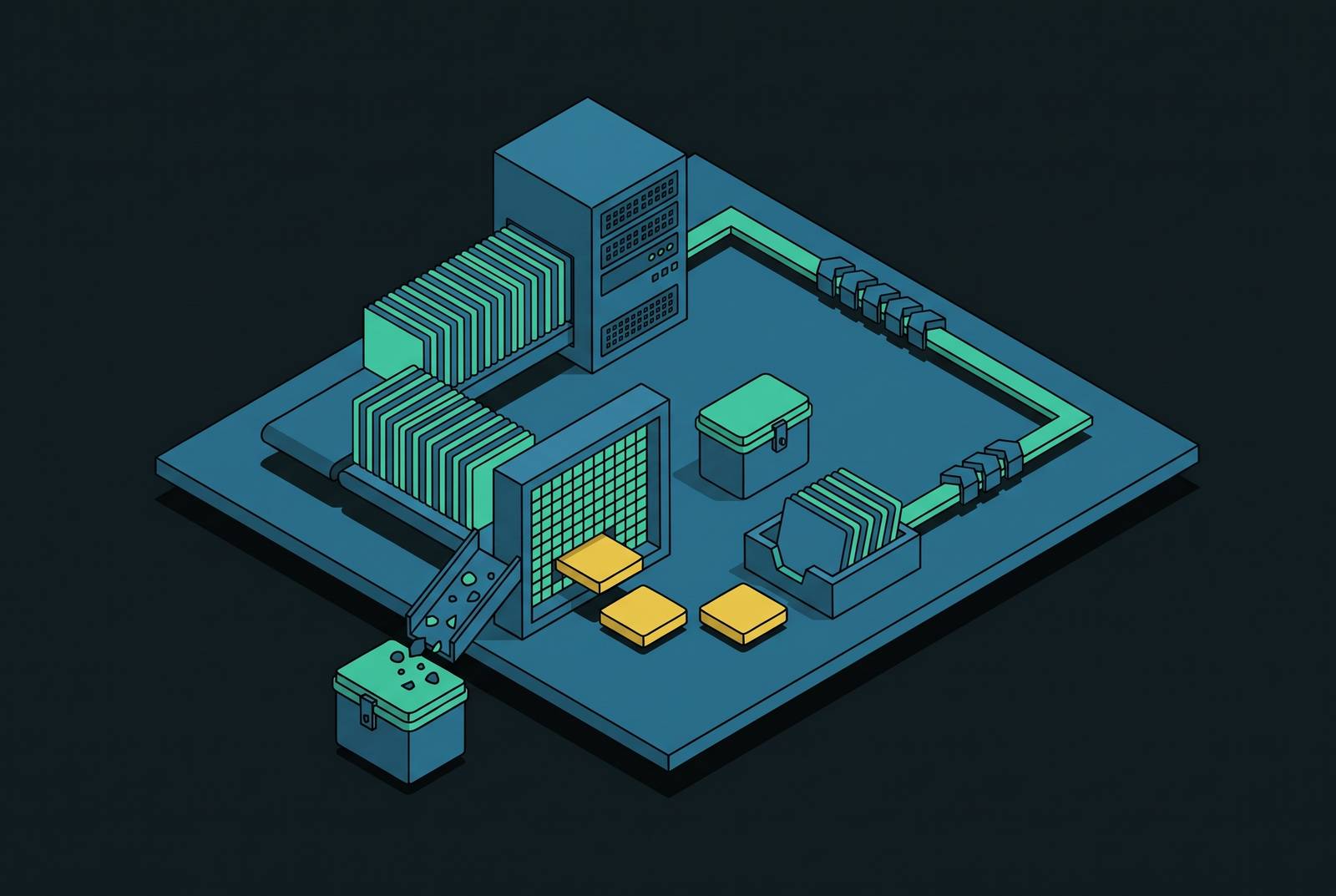
A harness engineering workflow driven by production traces filters failures, clusters patterns that keep coming back, ties each cluster to a root-cause layer, and routes it to the engineer who owns that layer. Fixes must then pass replay validation before they ship. The care taken between trace capture and backlog entry decides whether production evidence improves the agent or just adds more tickets to the queue.
Why collecting traces is not the same as improving agents
A tool call returns 200, but its output is corrupted. No exception is thrown, and the agent continues. By the time the defect becomes visible, the wrong tool may have been called on every request for weeks. Capturing that execution makes diagnosis possible, but it does not identify the defect or assign responsibility for fixing it.
At production volume, this gap becomes an operational problem. Tens of thousands of spans accumulate without anyone reading them, leaving teams with visibility but little differentiated signal. Monitoring can explain what an agent did during a given execution, yet raw collection and visualization cannot establish which problems deserve engineering attention next. The missing function sits between capture and backlog. It is a triage layer that turns execution evidence into an attributed problem.
What the firehose is actually made of: eight failure modes, three that dominate backlog noise
The failure landscape includes task drift, incorrect tool invocation, reward hacking, positional bias, mode collapse, degeneration loops, alignment faking, and version drift. These modes show up in agent loops, tool calls, and long-horizon tasks. Three recurring patterns create particular attribution trouble, namely tool schema drift, prompt ambiguity, and workflow loops. What teams see can lead them to blame the model before they check the harness.
Tool schema drift can corrupt outputs without producing an exception. JSON Schema validation at the harness registration boundary catches syntactic misuse, but it cannot establish that a tool description still matches the tool’s behavior. A syntactically valid call can therefore be semantically wrong. Prompt ambiguity creates a related problem because the failed output contains no reference for what an underspecified instruction was supposed to mean. In both cases, a model upgrade can look like the fix even though the fault is in the surrounding configuration.
Workflow loops make the distinction harder still. A broken exit condition and a genuine inability to complete the task can produce identical symptoms. As stale context degrades subsequent output, a workflow or memory defect can look like model drift. The symptom points away from its origin. Unless triage separates these possibilities, “model quality” becomes a destination for unrelated tickets that require different owners and different fixes.
Why root cause attribution is a search problem, not a lookup
Relevant evidence is often sparse and distributed across distant actions. The failure may show up long after the mistake that caused it, so the final symptom alone cannot reliably show what went wrong. One-shot LLM judges can work on shorter trajectories, but longer traces give them more opportunities to settle prematurely on a plausible explanation. Critical evidence then remains unexamined. Attribution must test competing explanations and revise them when contradictory evidence appears.
AgentDebugX (2026) places DeepDebug, a multi-turn root-cause diagnostic agent, at the center of this process. Its design combines low-friction capture, a portable representation with an OpenTelemetry GenAI export path, and typed diagnoses containing root cause, evidence, confidence, and fix. Local-first storage requires explicit scrubbing before sharing, while deterministic triage is free and deeper LLM analysis is opt-in. These operational constraints allow diagnosis to accumulate evidence without making every captured span an expensive investigation.
The Who&When framework (Zhang et al., 2025) identifies both the responsible agent and the decisive error step. AgentRx (Barke et al., 2026) localizes critical steps and assigns root-cause categories from execution trajectories. Multi-turn trajectory analysis achieves higher exact agent-and-step attribution than the strongest single-pass baseline on the Who&When benchmark. A triage system needs room to investigate before it commits a cluster to an owner.
The six layers a triage system must attribute failures to before anything reaches the backlog
The prompt layer contains ambiguous instructions, missing constraints, and underspecified output formats. Failures in this layer can look like model misbehavior even when the fault is in how the instructions were written. The tool layer contains schema drift, semantic misalignment between descriptions and behavior, and missing retry logic. Its symptoms include corrupted or absent output without an exception. These layers need different fixes even when their answers are equally poor.
The workflow layer governs exit conditions, state transitions, and loop detection, with failures appearing as runaway turns or apparent task abandonment. The memory layer governs the context retained or retrieved across execution. Stale context, unbounded accumulation, and irrelevant retrieval can degrade quality over a multi-turn session. That degradation can be mistaken for model drift. Distinguishing workflow from memory therefore requires evidence about both the path taken and the context available along it.
The product logic layer sits upstream of the harness, where an incorrect task specification can make the agent do exactly what was requested but not what was intended. The model layer is the remaining capability question, where a failure class may exceed what prompt or tool-description changes can resolve. It is not the default destination for uncertainty. Evidence must support that attribution, including the results of harness iteration. Across all six layers, investigation determines the category.
The TRAIL benchmark (Deshpande et al., 2025) uses annotated agent traces to localize the step, component, or interaction responsible for failure. MAST distinguishes specification mismatches, inter-agent miscoordination, weak verification, and cascading errors in multi-agent systems. These distinctions determine where a repair belongs. A generic “multi-agent failure” ticket discards them, leaving ownership and intervention unresolved.
How to use production traces to filter, cluster, and route failures before they become tickets
Filtering separates recoverable retries, expected edge cases, and known flaky conditions from genuine recurring failures. A week-to-week shift in tool-call distribution warrants investigation, and even a small increase in schema failures can be a leading indicator. An outcome verdict says whether an episode succeeded, whereas a correction supplies the verified action sequence after failure and supports layer attribution.
Clustering follows filtering because individual trace review does not scale. The cluster becomes the unit of investigation, with surviving traces grouped by symptom pattern. “Tool returns unexpected format” describes evidence without declaring its cause. In multi-agent systems, prompt-related clusters also need to distinguish planner, router, tool-use, reviewer, and sub-agent prompts as evidence identifies the implicated instruction. The agent surface where a symptom appeared is not necessarily the prompt that needs repair.
Once the evidence supports a layer, the ticket goes to the engineer responsible for that layer. A prompt defect is not automatically a model-team ticket, and a workflow loop is not automatically a prompt-engineering task. The order prevents premature assignment from hardening into diagnosis.
The full pipeline connects production traces, anomaly detection, human feedback, and trace-to-dataset regression coverage. Routing makes clear who owns the work within that pipeline. It also counters the tendency to revise prompts when the defect lies in harness, evaluator, or handoff design. A ticket routed to the right engineer names the layer at fault before that engineer opens the trace. The evidence can then guide a targeted change rather than another round of broad prompt experimentation.
Replay validation as the gate between attributed failure and shipped fix
A fix that has not been replayed against the traces that exposed the failure remains an untested hypothesis. Traditional logs cannot reproduce non-deterministic LLM failures, making span-based trace replay a baseline requirement for this workflow. The purpose is concrete and limited. Replay tests whether the change fixes the component that let the wrong state through, since a better answer on another run alone would not show that.
For that reason, evaluation must examine trajectory quality as well as outcomes. Transcript-centric evaluation scores the tool calls, reasoning steps, and retries along the execution path. A correct final answer alone can conceal an unchanged defect. Replay infrastructure therefore needs inputs, outputs, latency, and cost across LLM and agent runs, together with the ability to compare a captured trace against a new model or prompt. Prompt versions need the same tracking rigor as model versions so that comparisons remain attributable.
Replay also has a validity problem of its own. A recorded conversation was generated under a specific system context, and changing prompts or tools can make that conversation state unreachable. A comparison against such a state may no longer test the intended scenario. The practical mitigation is to pin tool versions in replay suites and introduce new versions through canary tasks.
Harness hill-climbing makes replay part of disciplined iteration. The process runs a benchmark suite, makes one targeted configuration change, re-scores, and keeps the change if the score improves. Isolation is essential to interpreting the result. Changing system prompt wording and tool descriptions in the same iteration conflates two signals, leaving the score difference unattributable to either intervention.
What the feedback loop looks like when it is working: signals, cadence, and the retraining boundary
A working loop continuously monitors tool-call distribution, schema-conformance, cost, and latency, then feeds those leading indicators into a weekly triage cycle. It does not continuously pour failures into the backlog. Execution logs, retry patterns, abandoned paths, and user corrections become evidence for a small, prioritized queue. Corrections receive particular weight because a resolved ticket, expert review, or policy ruling can supply the verified action sequence missing from a verdict. The cadence turns that evidence into investigation and replay-validated improvement.
This process also makes the harness-versus-retraining disagreement testable. The harness iteration position treats evaluation scores against production traces as the gradient signal, without model changes or retraining. The opposing position holds that some failure classes cannot be bridged by any prompt or tool description. Neither position should determine attribution in advance. When the same attributed cluster recurs across replay-validated harness iterations without improvement, the loop supplies evidence that the failure class may require model-layer intervention.
That boundary is a reason to preserve diagnostic history. A recurring symptom alone does not establish a model limitation, because the attempted harness fixes may not have addressed its cause. Repeated, layer-specific tests provide a stronger basis for escalation. In control terms, the harness closes the loop around the model, while stability, context drift, and control lag remain properties of that controller. A component change and a controller change are therefore different engineering decisions.
A team working this way reviews clusters instead of single verdicts, assigns fixes to the layer found at fault, and tests changes to that layer against captured failures. It retains regression coverage and revisits recurring clusters on the weekly cadence. Prompts, tools, skills, evals, and memory receive the rigor of code review and testing, the cadence of a sprint, and the reviewability of a pull request.