Workflow Orchestration and Memory Retrieval Failures Require Separate Signal Channels
Different failure layers need separate diagnostic signals to target fixes accurately.
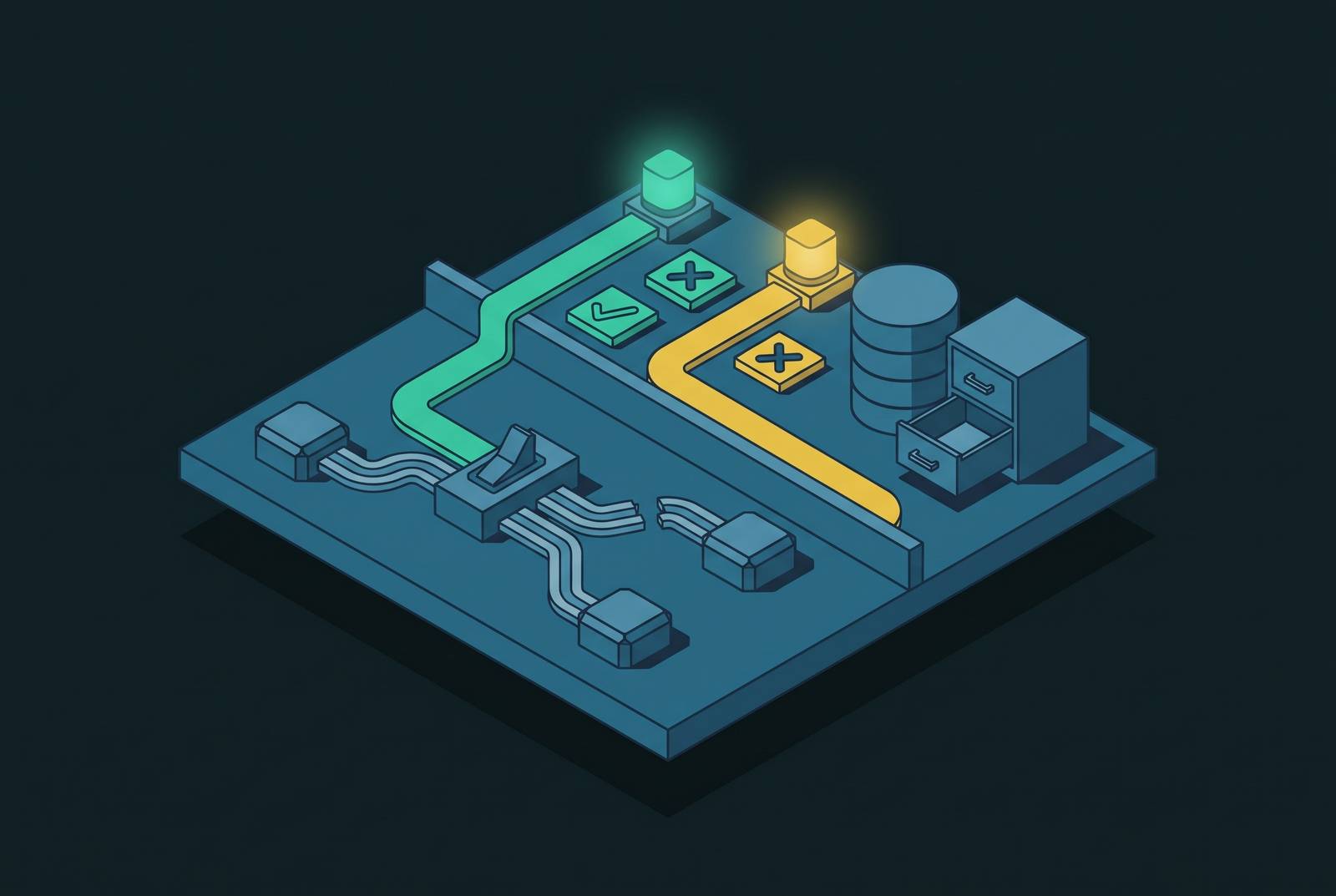
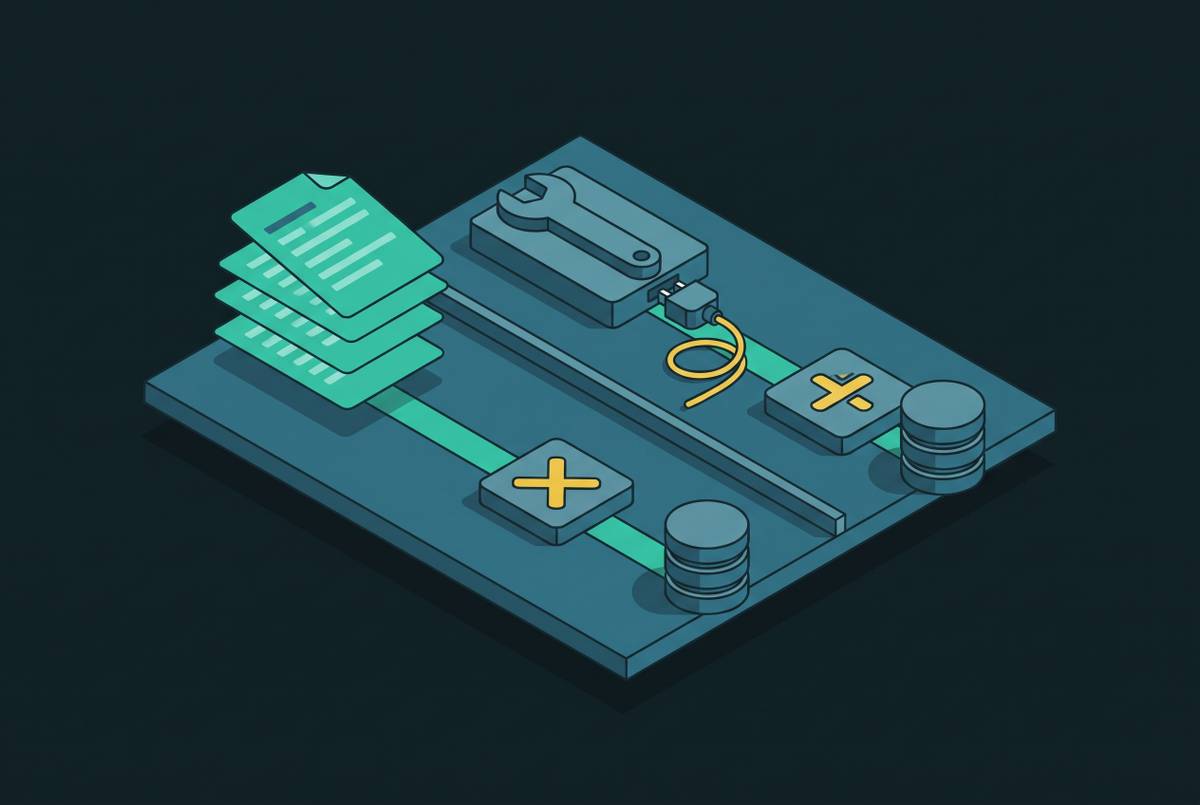
AI agent failure attribution by harness layer requires separate signal channels for workflow orchestration and memory retrieval. Orchestration evidence shows how execution was coordinated, while memory evidence shows what information was stored, retrieved, and used. A shared failure signal can identify a wrong answer without identifying its cause, leaving engineers unable to target and validate a layer-specific fix.
Why orchestration failures and memory failures belong to different failure populations
Orchestration failures originate in the control layer. They concern goal delegation, task decomposition, inter-agent handoffs, state tracking across steps, and termination logic. Memory retrieval failures originate in the persistence layer, where information is written, indexed, surfaced at query time, and incorporated into reasoning context. A run can follow the workflow as planned while using faulty memory, or use sound memory while following a faulty workflow.
Zhang et al.’s study of 409 bugs across five agentic frameworks separates Orchestration Fault from Cognitive Context Mismanagement in its root-cause taxonomy. The study also identifies Unexpected Execution Sequence, User Configuration Ignored, and Incomplete/Incorrect Trace as previously unreported symptom categories specific to modern agentic architectures. Those symptoms involve execution and how it is shown, and they do not line up neatly with memory failures. Yet both populations can end in a wrong answer, an incomplete task, or a loop. If both emit into one undifferentiated channel, every attribution attempt starts from ambiguity.
How orchestration failures propagate: the specific causal chain from control layer to terminal failure
An orchestration failure propagates through the execution trajectory. A misconfigured handoff, an unconstrained loop, or a misinterpreted task decomposition changes the state on which later steps depend. Later actions then build on bad premises, even when each action makes sense on its own. The causal chain is temporal and sequential. The terminal error may therefore identify a point where the run broke after the control failure began.
TRAJDEBUG illustrates this distinction with a CSV boolean export task in which modifying a forbidden file cascades into a JSON test failure. Treating the test result as the complete diagnosis would omit the decision that led to it. Attribution requires relating that action to the constraint established earlier in the trajectory. The distance between those events makes attribution harder.
TRAJDEBUG separates error trigger detection, error state classification, and critical attribution because a failed trajectory can have several local errors that affect the run in different ways. Some are repaired, some remain harmless, and some contribute to terminal failure. Its TRAJERRBENCH benchmark covers 486 manually annotated failed trajectories from τ²-Bench and SWE-Bench Pro, drawn from tool-use and coding scenarios in which the critical error can occur after earlier errors.
Repeated retries without a termination signal change step-count distributions, while actions taken out of order show up in execution sequences. Incomplete or corrupted handoffs are visible in inter-agent messages, and constraint violations become visible when an action is compared with earlier task requirements. These are relationships within the workflow trace. Memory read/write logs cannot establish whether a receiving agent was given the right state or whether a loop-exit condition was evaluated.
How memory retrieval failures propagate: a distinct causal chain through the persistence layer
Relevant information may never have been stored, or a write may have preserved too little detail. Compression can also strip out needed detail during summarization before it is stored. Engineers who see only the read cannot tell whether a record is missing or information was lost while that record was being prepared.
Retrieval introduces a separate set of causes. The system may surface stale entries or the wrong records because of embedding mismatch or an absent TTL policy. Even correctly retrieved content can be misapplied when it enters the reasoning context. Retrieval hallucination involves high-confidence use of irrelevant retrieved content.
These failures need not disturb execution order at all. The agent can take the intended steps, complete its handoffs, and terminate while reasoning from defective persisted information. The relevant evidence instead concerns which records were returned, when they were written, and what context triggered the write. Zhang et al.’s Cognitive Context Mismanagement category covers this separate concern with how context is kept, retrieved, and used. An orchestration observer can see an orderly run without seeing the defect.
The four memory-layer loci are write, compress, retrieve, and incorporate. Their separation prevents a missing-information diagnosis from becoming an automatic indictment of retrieval. Each locus has a different causal role, even when the final answer is equally wrong. At the endpoint, however, a wrong answer from bad retrieval can look identical to a wrong answer from a bad handoff.
How do engineers pinpoint the failed layer when both classes share one signal channel?
A channel that preserves only endpoint failure makes some attribution questions unanswerable. A wrong-answer event could reflect a stale memory entry, a bad handoff, retrieval hallucination, or a context-incorporation error. Without the corresponding layer evidence, those explanations remain observationally indistinguishable. More inspection of the same event cannot recover discarded distinctions.
This ambiguity encourages the symptom-as-cause trap. Engineers or debugging agents stop at the first visible error and treat it as the root cause, although it may be downstream of a failure elsewhere. A prompt patch applied to compensate for retrieval defects can then change orchestration behavior and introduce execution-sequence errors. The original memory defect may remain unresolved. A fix that seems to work proves little if the channel cannot show which mechanism it changed.
The model integration layer is the most bug-prone layer, yet it receives disproportionately low test inclusion during bug fixing. Tests need a defensible component target. When the evidence cannot show which layer failed, engineers are left unsure which component to test just when they need to check the fix.
Replaying an orchestration trace cannot establish whether memory retrieval behaved correctly, while a memory evaluation cannot by itself establish that execution sequencing remained sound. Neither result substitutes for evidence from the other layer.
What a dedicated orchestration signal channel must capture
The engineering response is to record execution’s causal structure. A dedicated orchestration channel must link each action to its triggering state, the agent that performed it, and its position in the sequence. That linkage lets engineers distinguish a defective action from an action performed against already corrupted state. Outputs alone cannot make that distinction. The trace must support attribution to the step causally connected to terminal failure.
Inter-agent messages also need explicit types, including request, inform, commit, and reject. Those types make coordination failures visible at the handoff rather than leaving engineers to infer them from the final answer. Termination tracking must record whether and when loop-exit conditions were evaluated and how many iterations elapsed. Constraint violations must be attached to the offending step. Execution-order deviations also need their own event type, since putting them in a generic error log is not enough.
AgentRx (EMNLP Findings 2026) operationalizes this approach through constraint synthesis. It derives invariants from the task specification, tool schemas, and execution trajectory, evaluates them step by step, and produces an auditable validation log. The resulting evidence localizes the critical failure step and classifies it within a grounded taxonomy. This is more specific than identifying a failed call. It relates the action to the conditions under which that action should have been valid.
The Buildrix deployment illustrates the diagnostic resolution such logging can provide. Its 12 failed tool calls span five main categories, namely data-schema mismatch, incorrect function usage, software-version incompatibility, invalid model parameters, and missing input dependencies. A generic tool-call failure would collapse these distinct causes. Step-specific evidence instead supports the distinction between an instruction or control problem and a failure in the call itself. Agentic Services Computing frames observable, auditable behavioral trajectories as first-class service properties, placing this requirement within the service lifecycle rather than treating it as optional endpoint instrumentation.
What a dedicated memory signal channel must capture
A dedicated memory channel must record writes, reads, updates, and deletes with enough context to locate the defective operation. Write records need the timestamp, triggering context, and content written, so missing information can be traced to storage. Compression attribution also requires evidence of what detail survived summarization. Otherwise, lost detail remains indistinguishable from an unsuccessful search. The channel must preserve the distinctions needed to explain what was available to retrieve.
Read records need the query, returned records, and relevance signal. Together, these distinguish a wrong-record failure from a no-record failure. TTL and staleness evaluations must appear as discrete events so that stale-entry contamination does not depend on manual inspection of every result. Context-incorporation traces must then show which retrieved records entered reasoning and when. That final link separates a defective retrieval from high-confidence misuse of irrelevant content.
Per-operation heartbeat telemetry shows that the memory operations themselves were observed. The instrumented production memory subsystem described in the brief achieved zero silent failures across tens of thousands of hook invocations through this mechanism. Its heartbeat rows also exposed the convergence from a high-failure first week to a single failure in the final five weeks. An aggregated error count would obscure that trajectory.
Changes to an embedding model, TTL policy, or compression scheme can affect retrieval quality without producing an orchestration anomaly. The evaluation needs memory-layer evidence. Its operational value lies in distinguishing write, compress, retrieve, and incorporate failures. A write-path repair is different from a retrieval-ranking repair, and neither can be selected from an orchestration trace alone.
Why channel separation is an engineering discipline, not an instrumentation preference
Separated channels make improvement claims testable at the layer they concern. An orchestration change can be evaluated against execution order, handoffs, constraints, and termination, while a memory change can be evaluated against persistence and context-use evidence. The other channel then provides the basis for detecting cross-layer regressions before shipping. Validation has a defined scope.
That discipline also governs learning from live traffic. Orchestration failures and memory failures that keep happening form different patterns because they follow different causal chains. Accumulating them separately allows those patterns to inform the corresponding harness improvements. Pooling them instead can produce a pattern that belongs to neither layer. Agentic Services Computing makes behavioral governance and service-level evaluation part of the lifecycle, so evidence must be set up to support attribution as the system runs and is improved.
The practical standard is a traceable path from failure to repair. Root-cause attribution finds the layer, replay checks the behavior at issue, and regression testing checks both the intended fix and what it changed elsewhere. Continual learning can then draw on failures whose causes have not been flattened into endpoint labels.
Sources
- Agentic Services Computing
- TRAJDEBUG: Tracing Error Lifecycle to Identify Critical Failures in Long-Horizon Agent Trajectories
- Understanding Bugs in Modern Agentic Frameworks: A Study of Symptoms, Root Causes, and Triggering Conditions
- Memory as Infrastructure: Reliability Engineering for Persistent Agent Memory in Months-Long LLM-Assisted Development