Why Prompt Tweaking Without a Trace Backlog Stays Ad Hoc Forever
Structured trace backlogs turn one-off prompt fixes into tested engineering.

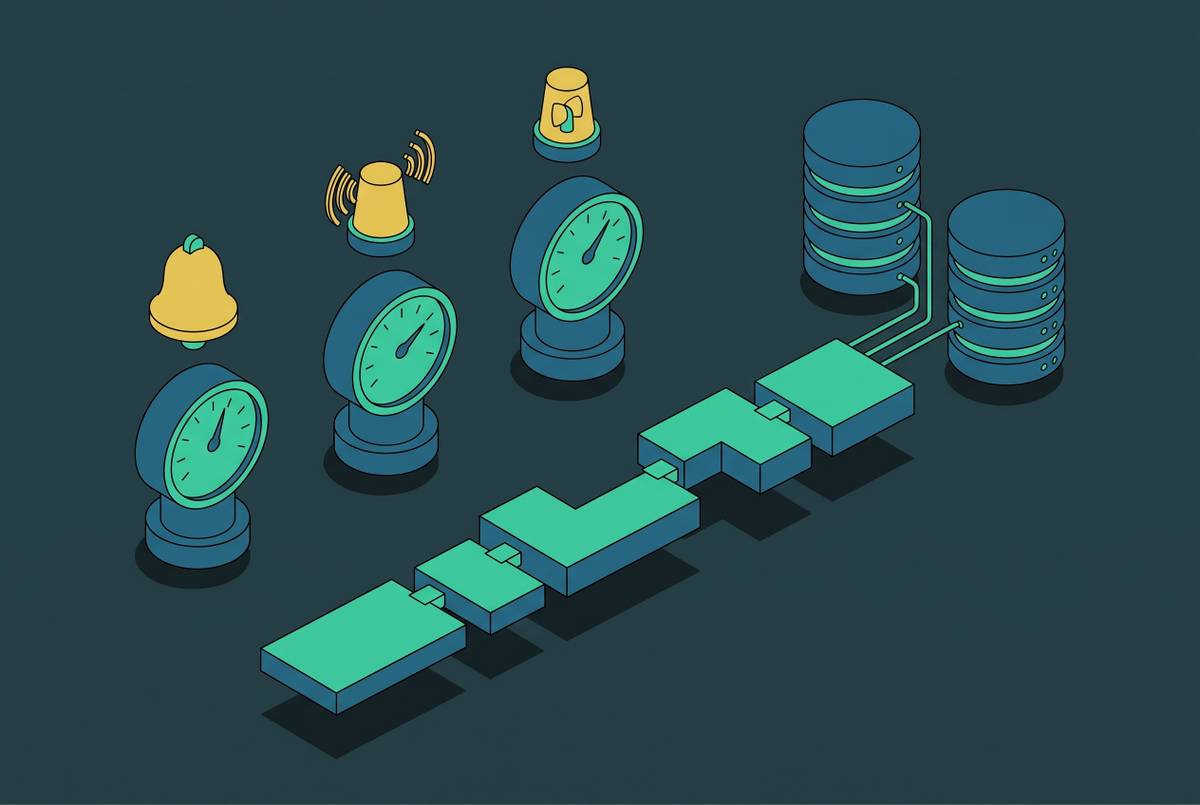
Without a trace backlog, prompt tweaking keeps chasing failures one at a time because each edit is tested against only the example at hand. A production trace-driven harness engineering workflow replaces that guesswork with structured capture, failure attribution, targeted changes, replay validation, and drift monitoring. The backlog is what connects those stages into an evidence-driven engineering loop.
Why ad hoc prompt tweaking is a structural problem, not a skill gap
An engineer changes a prompt, reruns the example that failed, and gets the intended result. The fix ships. Weeks later, a different manifestation of the same underlying failure appears, and another edit follows. Nothing in that sequence proves that the engineer was careless. The structural trap is that success on the example in view says little about the class of runs that share its root cause.
That trap is especially difficult to escape when agents fail quietly. Every call can return 200 while the task goes wrong, leaving no exception or stack trace to show where it broke. The response that attracts attention may be the final symptom of an earlier mistake in tool use, memory, or workflow logic. Without execution histories built up over time, the engineer cannot tell whether an edge case happened just once or keeps coming back.
Even a well-reasoned edit remains a local intervention if its effects cannot be assessed against prior failures. The next incident then starts the search over instead of adding evidence to the work already under way. The process has no memory of its own.
What production traces actually capture that one-off logs do not
A production trace records the execution behind an agent task, including every model invocation, tool call, memory read and write, decision branch, latency, and token spend. It contains more than a prompt and final response. Those endpoints show what was requested and returned, but not the chain of decisions between them. The trace makes that chain inspectable.
The task is therefore the unit of analysis. A single request can fan out across retrieval steps, tool calls, sub-agent handoffs, and retries. The failure may be several levels down that tree. Inputs, outputs, and version information attached to the run preserve the context needed to understand how those operations contributed to the outcome.
A single trace answers what happened during one execution. A backlog adds the dimension of recurrence, showing which failure modes appear repeatedly, which inputs trigger them, and which harness layers are implicated. That distinction separates an execution record from a body of operational evidence. The backlog also provides the history needed to establish behavioral baselines, although collection alone does not yet explain what problems the agent will encounter next.
The three failure categories a backlog reveals that one-off review misses
Tool schema drift is a mismatch that emerges over time. A downstream API changes its response shape, but the tool parser continues interpreting it under the old assumptions. No exception need occur, so corrupted outputs can continue flowing through the agent. A required field or deprecated endpoint can create a similar mismatch between the API and the signature the model uses. Comparing tool inputs and outputs across runs exposes the change against an established expectation, which one isolated execution cannot supply.
Prompt ambiguity has a different signature across the backlog. The model follows the literal instruction but fails to produce the intended behavior. One response may look like a weakness in the model, making an upgrade seem like the natural remedy. But when similar inputs lead to the same unintended reading, they point toward the prompt itself. The diagnosis depends on the repeated relationship between instructions, context, and behavior.
Diagnosing workflow loops requires comparing execution paths as well as outputs. An agent that cannot recognize task completion and a harness with a defective exit condition can produce the same visible symptom. Both keep running when they should stop. Inspecting multiple failing trajectories helps distinguish a completion judgment problem from a control-flow defect. Without that distinction, the engineer can change the wrong layer and leave the original cause intact.
Why root cause attribution requires the backlog to be precise, not just large
The Agent Delivery Engineering Predictive Reliability Framework, or ADE-PRF, documents “false prosperity” in July 2026 [1][2][3]. In unprotected environments, external observability metrics remain normal while actual output quality gradually degrades. The semantic gap between infrastructure health and correct behavior means that building a useful failure backlog requires behavioral evidence beyond operational logs.
Attribution requires locating the first divergence from correct execution. In a failed web-search task, the final agent may report “no results found” because an upstream agent formulated an overly restrictive query. The trace must preserve enough structure to connect the failed outcome to that earlier decision, rather than merely place both events in a long sequence of strings.
Production-grade debugging therefore needs structured traces with typed diagnoses, including root cause, evidence, confidence, and proposed fix. These fields make the causal claim explicit and expose the basis for it. Confidence also distinguishes a supported attribution from an unresolved hypothesis. More cases give engineers more to compare, but guiding a fix requires those cases to be structured. A large archive that records only where failure became visible still leaves engineers unable to identify what caused it.
What harness-layer attribution changes about where engineers look for the fix
Most production agent failures originate in the harness. The harness includes prompts, tools, memory, and orchestration logic, which encode behavioral rules, action schemas, prior observations, and reasoning procedures. Attribution shows which part of the harness should change before replacing the model becomes the default response.
LangChain improved its coding agent’s score on Terminal-Bench 2.0 by modifying the harness while keeping GPT-5.2-Codex unchanged. The benchmark result demonstrates that improvement need not require a different underlying model. It does not establish that every model is adequate for every task.
Co-Harness (2026) presents a substantive objection to treating harness work and retraining as alternatives. Its HarnessCritic proposes targeted harness edits from failed trajectories, producing cleaner trajectories that can then train a stronger model. Retraining is not excluded by this approach. The shared precondition is structured failure attribution that can guide both paths. Without it, neither a harness edit nor a training change has a precise connection to the observed defect.
Replay-based validation as the gate between a fix and a regression
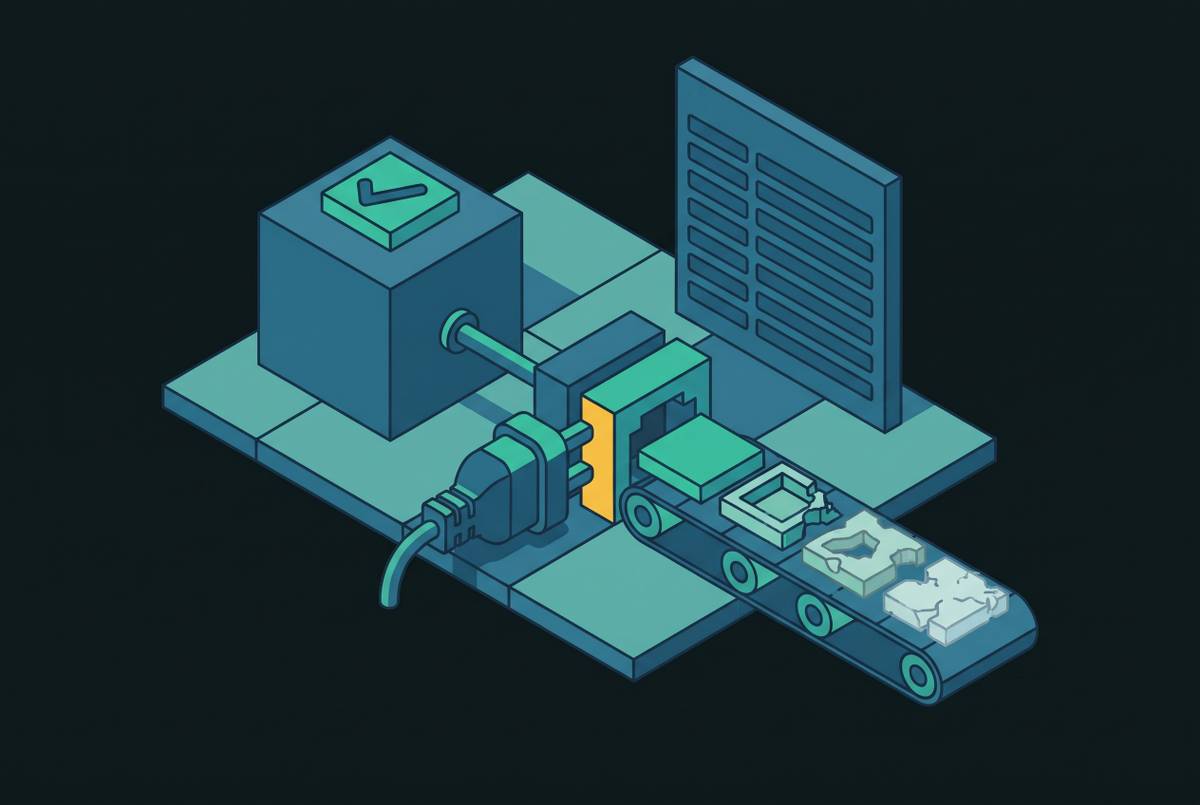
A prompt change that resolves one failure can quietly reintroduce another. The same engineer, or a different one, may later tune the prompt for a competing goal without knowing which earlier behavior the wording was meant to keep. The backlog closes the loop only when historical failures become a replay-driven regression set that gates subsequent changes.
The cleanest replay setup records exactly what the agent sends to each tool and what it receives back, plus minimal metadata. It then reruns the failing case using the recorded tool outputs and compares the resulting trajectory. The comparison includes tool choice, tool arguments, intermediate summaries, and retries. This makes the test more revealing than a final-answer check because it shows whether the proposed change altered the behavior responsible for the failure.
Harness evolution itself also needs this protection. EVOHARNESSBENCH (2026) examines agent performance under controlled growth of the externally supplied capability surface and identifies harness-induced forgetting and inconsistent adaptation as failure categories. A change must pass against the triggering case and the regression tier before it reaches production.
AWS’s AgentCore Optimization illustrates this gate within a broader operating loop. It analyzes production traces and evaluation outputs to recommend system prompts and tool descriptions, then uses batch evaluations against predefined test cases. Live A/B tests check the changes further before they are promoted.
How the backlog enables predictive monitoring once behavioral baselines exist
Once a backlog is long enough and structured enough, its value extends beyond diagnosing past failures. It becomes the basis for distinguishing ordinary variation from emerging degradation. Raw collection and visualization cannot supply that distinction on their own. Statistical anomaly detection needs behavioral baselines to distinguish meaningful deviations from ordinary execution variation.
ADE-PRF aggregates heterogeneous runtime signals across five layers into a single Trust Margin metric. It reports forecasts of health over the next 8-hour period with 76.8% Direction Accuracy. Those results depend on continuously accumulated structured production data. It was tested in production across six agent profiles that ran continuously over a long period. The Trust Margin links to ground-truth system states only once the data the framework collects is flowing.
This capability addresses a changing operating environment in which model versions shift, tool schemas change, and production inputs move away from the data used to build the evaluation set. A historical baseline gives active drift detection a reference point. Subject-matter experts can also annotate bad traces, turning raw production failures into labeled signals for improvement.
The investment therefore compounds before predictive monitoring is in place. A team collecting and structuring traces today is building the baseline that can support that capability in six months. A team relying solely on ad hoc edits creates no comparable history. It forecloses the option until collection begins.
How do engineers use production traces to systematically improve an agent?
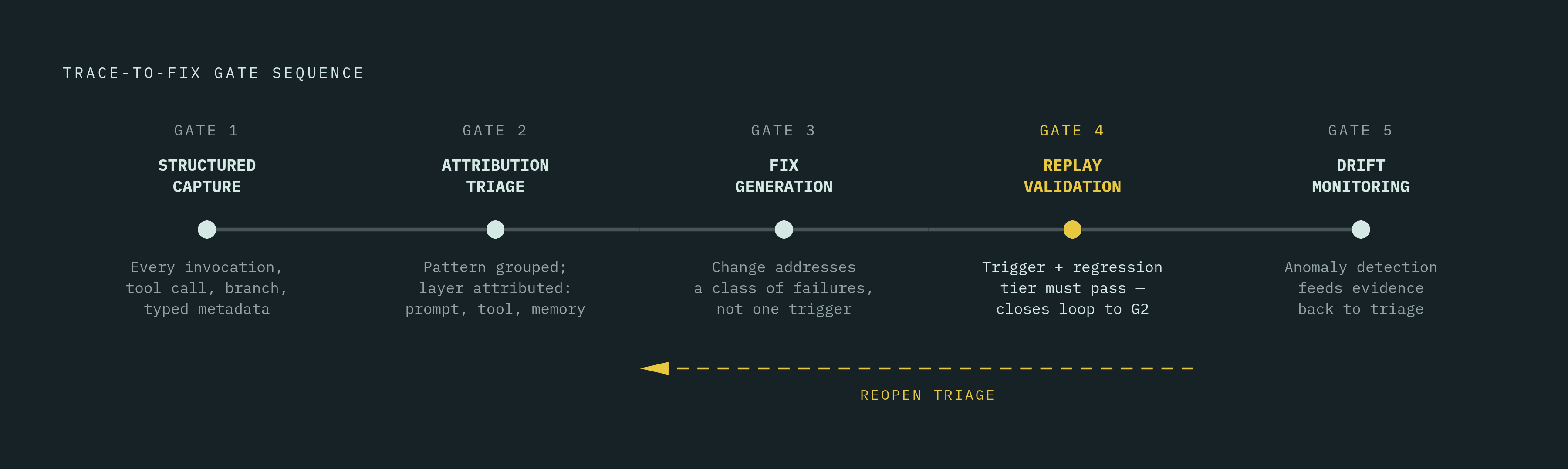
A systematic trace-to-fix workflow treats each stage as an engineering gate. The first gate is structured capture, with every model invocation, tool call, memory read and write, and decision branch instrumented using typed metadata. OpenTelemetry GenAI semantic conventions make traces portable and comparable across vendor changes. A team does not need every later gate in place before its first structured trace has value.
The second gate is attribution triage before any fix is attempted. Failing traces are evaluated and grouped by recurring patterns, then attributed to the responsible layer, whether prompt, tool schema, workflow logic, memory, model, or product logic. The diagnosis must connect the observed outcome to evidence in the execution. A failure assigned to the wrong layer sends the next stage in the wrong direction.
The third gate is fix generation against the backlog. Proposed prompt, tool schema, or workflow changes address a class of failures that includes the example that surfaced. The fourth gate is replay validation before shipping, covering both the triggering failure and the historical regression tier. A plausible edit is still only a candidate. It must demonstrate the intended improvement without reopening failures that previous changes resolved.
The fifth gate is continuous drift monitoring, which starts once behavioral baselines are in place. Automated anomaly detection then surfaces new patterns before they accumulate into user-reported incidents, feeding evidence back into triage. Each stage needs identifiable ownership and inspectable decisions. Harness engineering should have the same expectation of reviewability and auditability as code review and testing, rather than depend on black-box fixes that developers cannot examine.
This discipline can be built incrementally because its stages share one durable asset. Each validated fix adds to the regression tier, and each regression tier makes the next change cheaper to assess. Every structured trace added to the backlog increases the evidence available for subsequent attribution, validation, and monitoring.
Sources
- Agent Delivery Engineering Predictive Reliability Framework
- From Failed Trajectories to Reliable LLM Agents: Diagnosing and Repairing Harness Flaws
- AgentDebugX: An Open-Source Toolkit for Failure Observability, Attribution, and Recovery in LLM Agents
- What Is Agent Observability? A 2026 Developer Guide
- When Errors Become Narratives: A Longitudinal Taxonomy of Silent Failures in a Production LLM Agent Runtime
- REPLAY FIDELITY IN LLM AGENT EVALUATION Preprint preparation
- [2611.11216] Replay Fidelity in LLM Agent Evaluation: Randomness, Hidden State, and Test Oracles in AppWorld