Degraded Output Quality With No Error Traces Is a Tool Failure Signal Not a Model Regression
Silent quality drops usually start in the tool layer, not the model.
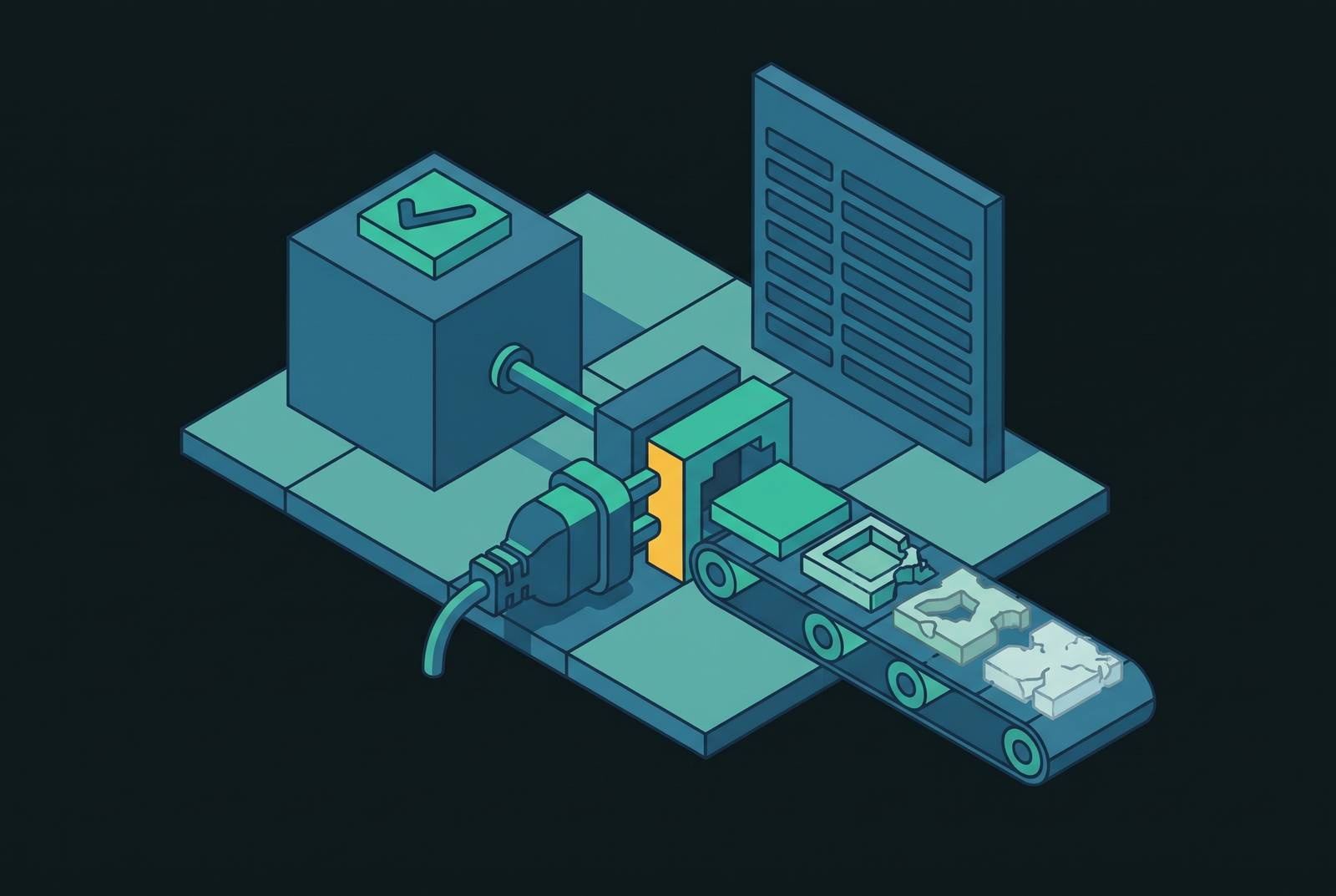
Degraded output quality with no error trace is a signal to investigate the tool layer before blaming the model. To detect silent tool failures in production multi-agent pipelines, teams need per-span quality scores, tool-call baselines, and linked execution traces. Infrastructure health cannot establish task correctness, and a model replacement cannot repair missing context, schema drift, or a broken workflow.
Why degraded output quality with no error trace is a structurally different kind of failure
Dexing Liu’s 2026 study documents a production deployment spanning over 100,000 agent interactions in which a multi-agent orchestration system ran reliably for weeks. There were no code changes, model updates, or configuration modifications. On the 47th day, Agent A failed to pass critical context to Agent B. The task completed with subtly degraded output, without an error message, timeout, or resource bottleneck. The operator noticed three cycles later, after the error had propagated.
Silent failure means that task completion conceals a deviation from intended behavior. The process keeps running and the request finishes. Unlike a crash or resource shortage, the defect does not necessarily produce a transition that an infrastructure dashboard can recognize. A successful execution status therefore provides no evidence that the required context reached the next agent.
Liu’s Entropy Principle describes disorder accumulating across interaction cycles until output consistency, task accuracy, and cross-session coherence deteriorate. The visible complaint is not necessarily the beginning. Engineers must locate the first departure from correct behavior rather than treat the first reported bad answer as an isolated event.
Why standard infrastructure monitoring is structurally incapable of detecting this failure
Standard infrastructure monitoring measures uptime, latency, error rates, and status codes. Those measurements describe execution health. An HTTP 200 response can contain an empty or semantically wrong payload. The transport succeeded while the task lost its foundation. Adjusting an error-rate alert cannot detect a defect that never changes the error rate.
Priyanka Bajaj’s 2026 research defines this mismatch as “evaluation blindness.” A measurement function exhibits it when a failing system produces a value indistinguishable from a non-failing state, with no auxiliary signal exposing the difference. Bajaj’s analysis of 50 real-world production incidents found that 53% of verifiable public incidents documented in court records, regulatory filings, and public postmortems were silent failures. A monitor cannot distinguish states that its measurements represent identically.
The UK Post Office Horizon system shows the danger of taking recorded output as ground truth. Outputs were logged, audited, and acted upon, but the audit function itself was broken. More records did not provide an independent correctness signal. Agent workflows add another gap because intermediate decisions may never enter a log, and downstream reasoning can proceed confidently over bad data. To piece together what happened, the tool calls, parameters, returned values, and decisions that followed must be linked into a full execution trace.
Why the instinct to blame the model is predictable but almost always wrong
The model is the most visible source of an agent’s answer, so it becomes the default suspect when that answer deteriorates. Model behavior also has more tooling around it than harness state. Yet Liu describes failures under controlled conditions where prompts were static, models were identical, databases were fixed, and there were no external inputs. A new model change cannot explain failures in general when they also happen under those conditions.
Execution and tool-layer failures account for a substantial share of incidents, while silent data and context failures form the largest category described in the notes’ production taxonomy. Bajaj identifies the Operational class as entirely silent by structural definition. Genuine model regression remains possible, but it should become the working hypothesis only after the surrounding execution path has been examined.
Propagation distance explains why symptom-level investigation repeatedly misattributes the defect. The node producing the visibly wrong answer may sit several steps downstream from the node that first lost or corrupted information. Its reasoning can be consistent with the input it received. Changing that node’s prompt may change the symptom without fixing the upstream cause.
The specific harness failure modes that produce clean infrastructure signals and degraded outputs
Tool schema drift occurs when a harness continues using assumptions from one input or output schema after the tool changes. A call may be rejected, silently misinterpreted, or followed by a null response that the agent accepts. The misleading signal is a completed call. Even a correctly shaped response can contain the wrong content, which smaller models are particularly poor at recognizing. Schema validation catches syntax defects, while cross-call consistency checks are needed to expose semantic drift.
Prompt behavior drift changes the relationship between instructions and behavior. A provider can update serving infrastructure while the team’s system prompt remains unchanged, or an intentional tone improvement can inadvertently weaken task reasoning. A documented September 2026 production scenario involved a routing accuracy regression of more than twenty percentage points following a silent provider update. No test caught it and no alert fired. Normal latency and expected token counts concealed the deterioration until customer complaints surged.
Workflow loops and missing termination conditions break progress. Without a verifiable done-condition, an agent can retry until it exhausts its token budget or stop producing output without an error signal. Two agents can also loop because neither produces an answer that satisfies the other’s termination condition. Rising step counts expose looping. Silence exposes paralysis. Argument-hash repetition and retry-variance delta provide more stable and cheaper loop signals than entropy-slope monitoring.
Skill/library drift is a separate kind of failure that builds up in self-evolving systems. Unbounded skill accumulation introduces retrieval disorder as the library grows. No individual retrieval call needs to fail. Skill/library drift causes a slow drop in task success across workflows that depend on skills, with no matching infrastructure anomaly.
How multi-step propagation turns a single tool failure into a system-wide quality problem
A tool-layer defect becomes more destructive when later steps treat its output as valid input. If an early retrieval returns the wrong context, the next step can produce a malformed result, and a later step can reason confidently from it. Each dependency extends the damage. The final answer may still make sense on its own because its logic rests on a false foundation. Evaluating that answer alone cannot reveal where the foundation changed.
The consequences can also extend beyond text. A hallucinated tool parameter may create a record that did not exist, trigger a process that is difficult to reverse, or charge a payment that should not have been made. As the workflow proceeds, a bad input can become the premise for further actions. A locally plausible decision can therefore deepen a system-wide failure.
Liu formalizes accumulating disorder through the Entropy Principle, S(t) = S₀ · e^(αt), with α measured empirically across multiple architectures. Disorder compounds across interaction rounds. Single-step evaluation can miss an agent that reasons correctly, selects the wrong context, and then acts consistently on that context. Diagnosing it requires the full trajectory, including the earliest tool anomaly and the decisions that depended on it.
What to instrument to catch tool failures before they surface as user complaints
The instrumentation response requires three continuous measurement layers in production, supported by structured execution traces. For output quality, record a score for each agent response covering factual grounding, instruction following, format correctness, and decision appropriateness for its context. Store scores per span, including at the terminal answer. The baseline is the distribution over time. Alert on deterioration in that distribution so that mid-chain quality loss becomes visible before it reaches the user.
For tool behavior, record which tools are called, their order and frequency, their inputs, and their returned values. Establish distributions during a stable period, then monitor departures in call patterns and schema behavior. Valid syntax is not sufficient evidence of correctness. Compare whether similar inputs produce structurally and semantically consistent outputs across calls. A deviation in that relationship provides an earlier drift signal than waiting for the final answer to fail evaluation.
For trajectory coherence, score whether the retrieved context supports the task that follows and whether verification takes place when the task calls for it. Set a baseline for these relationships and step-count distributions while the system is running well. Alert on departures, including rising step counts, repeated argument hashes, changing retry variance, and absent expected output. Looping and paralysis require different detection signals. Neither should depend on an exception appearing first.
These measurements require logs of every model invocation, tool call, memory read or write, and decision branch, with causal links between actions. Otherwise, a quality alert identifies a bad span but leaves its origin unresolved. The trace must support both counting and reconstruction. It provides the connection between a changed tool response, the context an agent received, and the decision that followed.
How do you distinguish model regression from harness failure using production traces?
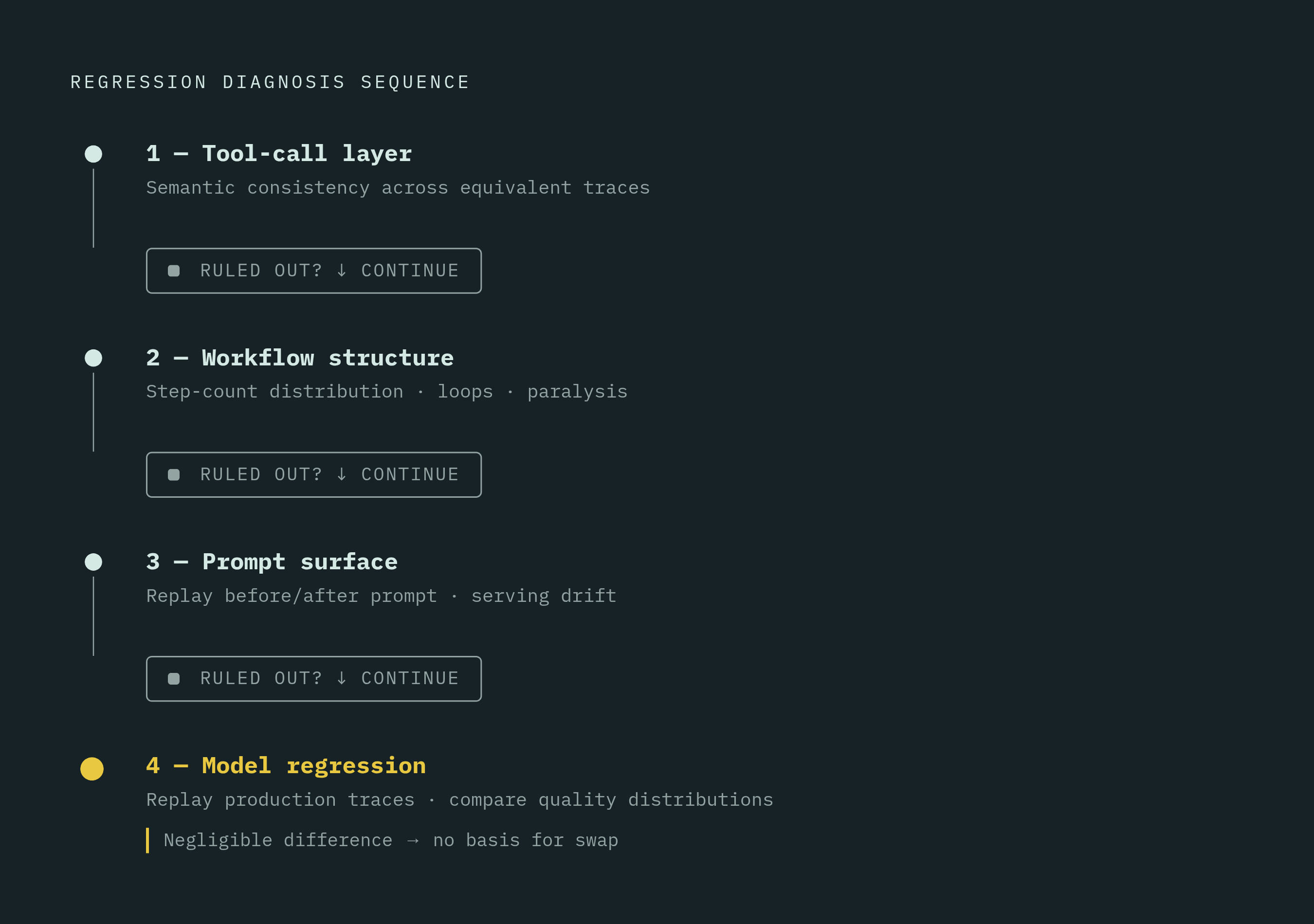
Start at the tool-call layer by comparing results across traces with equivalent inputs. Check that the outputs remain semantically consistent before examining the model’s reasoning over them. If they do not, investigate the tool layer first. A downstream reasoning failure cannot establish model regression when the evidence supplied to the model has already changed.
Next, compare step-count distributions over the time when quality fell. Step counts that rise while error rates stay flat point toward loops, while a lack of output with no error points toward paralysis. These observations narrow the investigation to workflow behavior. Inspect the termination conditions and intermediate transitions represented in the traces before attempting to improve the final response.
If tool results are consistent and step counts remain normal, isolate the prompt surface. Check for prompt-template changes and possible provider-side serving changes, including ones the team did not start. Replay the same traces against the prompt before and after the suspected change. Recovery with the original prompt implicates the prompt layer. Provider-side behavior drift can still occur when the local prompt stays the same.
Only after tool schema drift, workflow structure, and prompt-surface changes have been ruled out should model regression become the working hypothesis. Replay the same production traces against a model that might replace the current one and compare output-quality distributions. A negligible difference provides no basis for expecting a model swap to solve the defect. Attribution must identify an actionable layer, rather than merely name the component producing the final answer. The replay evidence then becomes the basis for validating the proposed repair.
Why fixing a harness failure without replay validation against real traces is shipping blind
A plausible harness fix is not yet a validated fix. Synthetic tests may omit the interaction sequence, tool-response pattern, and accumulated context that produced the production failure. Non-determinism further limits what a passing test establishes. A failure observed in production may not reproduce reliably in a controlled environment, and unchanged code can behave differently across runs. Replay against the relevant production traces tests the proposal against the conditions that exposed the defect.
The engineering loop begins by turning representative failing traces into test cases and developing or tuning an evaluator against them. The proposed fix is then replayed offline, and the evaluator returns to production monitoring. Promotion requires an explicit acceptance rule. Proposed edits should improve performance without causing regressions on traces that passed before, with regression testing on held-out tasks. That rule tests whether the repair resolves the failure without displacing it elsewhere.
The reference set also needs maintenance from live traffic as schemas, provider behavior, and request distributions change. Automated proposals need the same evidence as edits made by people. Harness changes drawn from clustered failure patterns must stay open to review and pass held-out regression testing before promotion. The production trace is the source of truth for both locating the failure and demonstrating that the repair works.