MCP Tool Testing and Evaluation for Agent Harnesses
Five testing layers catch failures that single-layer evaluation misses entirely.
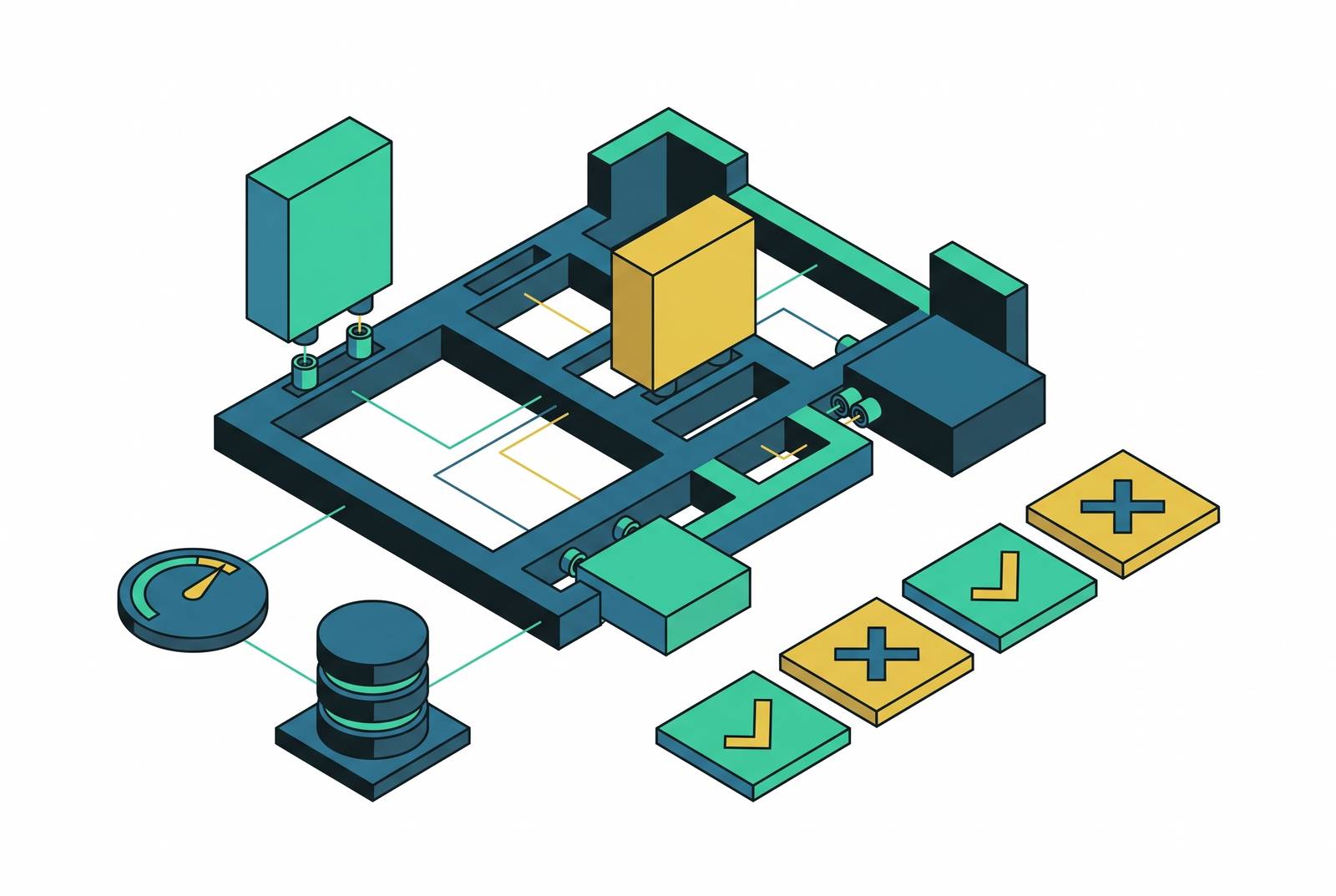
Agent harnesses that rely on Model Context Protocol tools need testing at five distinct layers, not one: tool description accuracy, call success, result integration, workflow-level side effects, and security. The dominant failure mode in production MCP deployments is not skipped testing. It occurs when testing happens at a single layer while a team assumes coverage across all five, a gap that surfaces only once the harness is live and a failure traces back to a layer nobody was watching.
Why MCP tool testing is not a single gate
Most teams running MCP-powered agents have some testing in place. They validate that tool calls return successfully, or they spot-check outputs against a handful of known prompts. The trouble is that MCP servers function as two products inside one binary: a functional surface, covering tool descriptions, call success, and result integration, and a security surface, covering injection, tampering, and isolation. Tool catalogs in 2026 change often, and a schema, description, or permission set that passed every check last sprint can be structurally broken this sprint with no alert firing, because the test suite covering it addressed only one layer and the change happened at another.
The agent harness and where MCP tools sit inside it
The term "harness" gets used loosely, often as a stand-in for the orchestration framework or even the model itself. The harness is the operational scaffolding that wraps a language model in production: it runs the ReAct loop, queries persistent organizational memory, invokes tools through MCP, tracks token budgets against a cost ceiling, and halts execution when a guardrail trips. MCP tools are the mechanism through which the agent acts on anything outside its own context window, and this scaffolding does not bolt them on as an optional extra, which makes tool correctness a reliability concern on par with prompt quality or workflow logic, not a secondary one. The harness sits structurally between two systems that each see only part of the picture. Gaps in harness testing are invisible to both neighbors. The layered discipline has to live inside the harness itself rather than being assembled from eval and observability tooling after the fact.
Layer one: tool description quality as a first-class test target
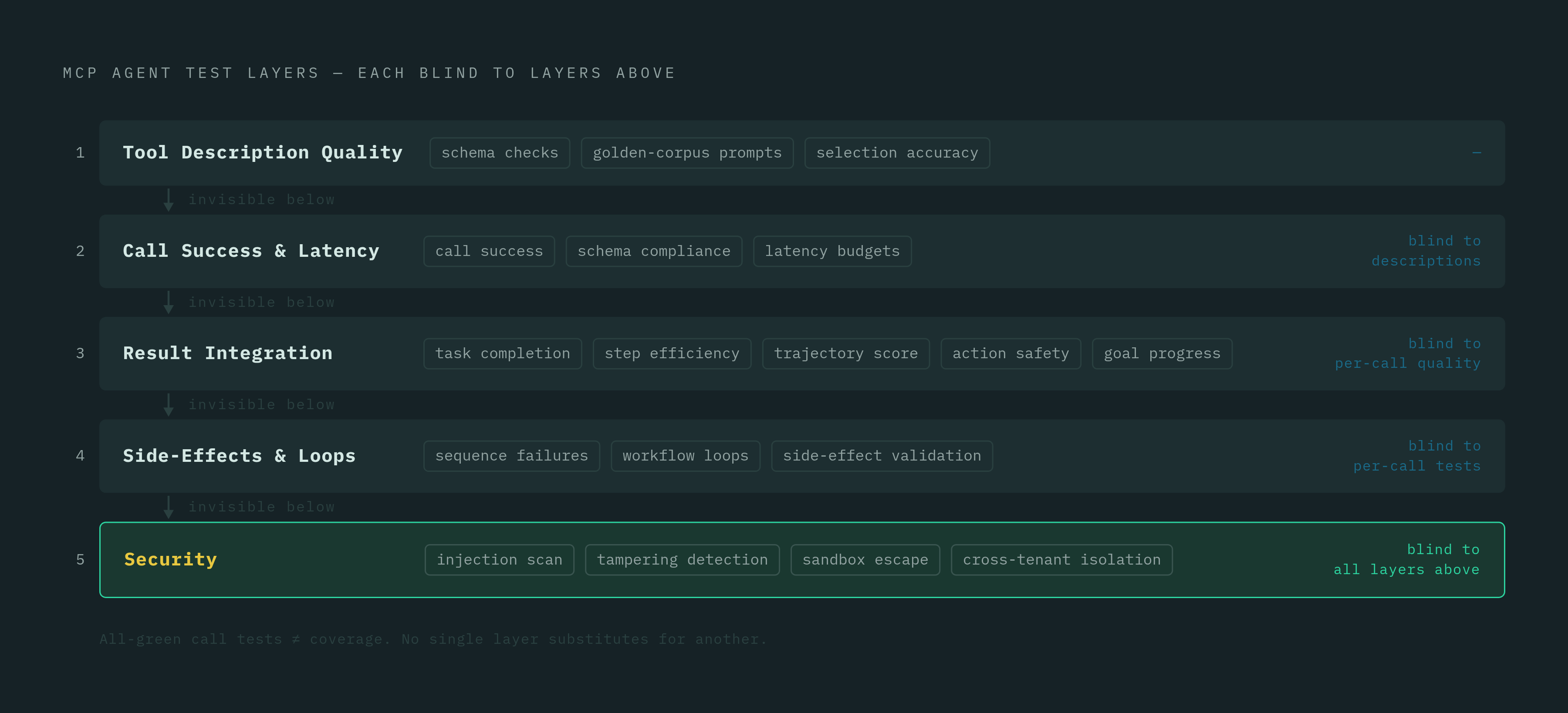
Tool description quality is the cheapest layer to test and the one most teams skip. Catching this requires two separate passes. The deterministic pass validates the JSON schema against the tool's real signature: a required field missing from the schema, an integer field typed as a string, an enum value that no longer matches the runtime allow-list. The semantic pass is harder and more often skipped entirely: running a golden corpus of prompts that should and should not trigger a given tool, then scoring selection accuracy against both sets. If a description overpromises, you get a precision problem, where the agent calls a tool for tasks it cannot actually handle. Both failure types collapse into the same aggregate accuracy number and only separate once a confusion matrix is built, which is one reason the semantic pass gets deprioritized even on teams that run the deterministic one. No metric downstream of tool selection can see description accuracy, so a call-success test suite, however rigorous, cannot substitute for it.
Layer two: call success, schema compliance, and per-tool latency budgets
Passing the description layer does not guarantee a successful call. Three conditions have to hold at once for a tool call to succeed: the agent selects the correct tool, the arguments it generates validate against the tool's schema, and the server returns a valid response inside its latency budget. Each of these is independently testable, and each fails independently of the others. Latency deserves the same discipline as correctness. Because MCP tool catalogs change quickly, tools deserve treatment as versioned dependencies with explicit contracts: a schema change is a breaking change, and it should pass through the same review gate a breaking API change would trigger in any other service.
Layer three: result integration, when a 200 response still breaks the chain
A tool call can return a perfectly valid response and still break the task. Call-success metrics cannot see this layer by construction, because the call succeeded by every measure they track. Multi-step trajectory evaluation catches this by inspecting the agent's intermediate chain of tool choices and reasoning steps alongside the final answer. Seven metrics scored from a trajectory of steps, tool calls, and an expected goal cover this ground: task completion, step efficiency, tool selection accuracy, a composite trajectory score built from the first three, goal progress, action safety, and reasoning quality. These run as inexpensive heuristics in continuous integration and as judge-augmented rubrics once the harness is live, and they are the only layer that reliably catches a call-success metric sitting green next to a broken chain in the same trace.
Layer four: side-effect validation and workflow loop detection
Some failures exist only at the level of a sequence of calls, and no amount of per-call testing catches them because no single call in the sequence is wrong. Agents mutate state through tools: creating records, running queries, committing code, issuing refunds. Workflow loops have a signature specific enough to make them a mechanical check rather than a judgment call: identical tool calls repeated multiple times with identical arguments, or the same tool invoked repeatedly after a terminal error. Either pattern belongs in continuous integration as a hard gate, not a heuristic flag. Remediation from this layer needs explicit, typed boundaries rather than a blanket retry policy: timeouts and transient 5xx errors should retry, schema-invalid requests and auth-failure 4xx errors should abort rather than retry blindly, and ambiguous partial failures or exhausted budgets should route to a human. A related failure mode, formalized as "Ambiguity Collapse," occurs when an agent resolves an underspecified instruction by silently picking one interpretation and proceeding. It does not appear as a call-level error, because every individual call in the resulting sequence can be valid. It appears only as an unexpected action sequence at the workflow level. The action safety metric therefore belongs at this layer rather than at call success, since safety violations typically emerge from a sequence of otherwise-valid actions, not from any single call.
Layer five: security evaluation as a structural requirement, not an audit step
An MCP server's security surface is structurally wider than that of a fixed-tool agent, because the tool catalog itself is part of the prompt the model reads, and the supply chain underneath that catalog changes with every dependency update. Description injection, result tampering, sandbox escape, and cross-tenant data isolation are failure modes that functional testing has no mechanism to catch, since none of them involve a malformed schema or a slow response. Four checks belong in every MCP evaluation pipeline for this reason: a tool-description injection scan, tool-result tampering detection, sandbox and permission-escape attempt detection, and cross-tenant data isolation verification. Treating security as a review phase that follows functional sign-off creates a specific coordination failure: a change that passes functional CI and sits waiting for separate security review has, in practice, already gone live in the catalog by the time that review happens. Functional and security evaluation need to share one trace tree and run in parallel on the same change, not as sequential gates.
Compatibility testing across model and client configurations
The same MCP tool, with the same schema and the same description, does not behave identically across every model and client. MCP standardizes the interface between agent and tool, not the model's interpretation of that interface, so Claude, OpenAI, Gemini, and Cursor configurations can each produce different tool-selection and argument-generation behavior from the identical tool definition. MCP became the consolidating protocol across the industry in 2025 largely because it let teams swap foundational models without rewriting their integration layer, but that interoperability guarantee operates at the protocol level, not the behavioral level. Compatibility testing checks the gap between the two. The ActiveAgent dashboard MCP server, introduced in September 2026, shows what a closed version of this loop looks like inside a developer's own coding environment: it lists evaluations, runs them against a checkout sandbox, surfaces fix items and the failing traces behind them, re-runs after a fix is applied, and compares results across model configurations, all without the developer leaving the development environment.
Root-cause attribution must name the layer, not just the outcome
Knowing that a run failed is not the same as knowing why, and outcome-level signals alone give a team nothing to act on. A failed task could trace back to a description drift, a schema mismatch, a result integration gap, a workflow loop, or a security violation, and without knowing which, any fix attempted is a guess. Root-cause attribution turns an outcome into a directed intervention by assigning fault to the component actually responsible, whether that is the model, the harness, the environment, or the grader scoring the run, and that assignment determines where the fix lands: a prompt edit, a tool schema correction, a workflow policy change, or a benchmark repair. As agent logs grow longer, the evidence needed to explain a given failure can be sparse, can appear much earlier in the trace than the point where the failure became visible, or can be scattered across distant steps. This turns attribution into a search problem. AgentDebugX's DeepDebug component performs multi-turn root-cause diagnosis using global trajectory understanding and cross-examination across steps, reaching 28.8% exact agent-and-step accuracy on qwen3.5-9b against 21.7% for the strongest single-pass baseline on the Who&When benchmark, which demonstrates that trajectory-aware attribution is solvable engineering, not a research aspiration still waiting on a breakthrough. Teams that skip this specificity tend to default to blaming the model and reach for retraining or a model swap, when the failure sat in the harness the entire time and was fixable without touching a single model weight. A gap at any one layer of MCP tool testing leaves the rest of the harness blind to a real failure, and production-trace analysis is built to surface exactly that gap. Moda's automated failure diagnosis identifies which layer, tool description, call success, result integration, or workflow, broke a given agent run, which makes it possible to design tests that close the specific gap a single-gate evaluation would have missed.
Replay-based validation before shipping any harness change
A fix that passes every synthetic test case can still regress the moment it meets live traffic, because synthetic cases were built against the original product spec and the product has moved since. Agents routinely pass a high share of golden-set tests while failing on a much larger share of real traffic, and that gap is the entire argument for replay. Replay-based validation runs a proposed change against historical traces, including the specific failing traces that motivated the fix in the first place, and scores the results before anything ships. This gives you actual evidence that a fix resolves the failure it was meant to resolve without introducing a new regression somewhere else in the trace set, rather than relying on confidence that the change looks correct. Description regressions present as model reasoning failures in the logs, but the root cause lives in the harness. A team can act on that distinction by replaying historical traces against a candidate description fix before shipping it, confirming the corrected description actually recovers the affected runs. A mock MCP server that records and replays tool responses is what makes this tractable at the speed engineering teams need: tests run without hitting external networks or mutating production state, they finish in seconds rather than minutes, and they return a stable, repeatable result that can gate a build in continuous integration. The ActiveAgent MCP dashboard tools, also from September 2026, close this loop with a specific mechanism: evaluation_runs_compare returns a result-by-result breakdown of what changed, fixed, regressed, still_failing, added, and removed, so a developer sees what a fix changed before merging it, and the trace_id link ties each evaluation result back to the production trace that generated it. Shipping a harness change without this step is the equivalent of shipping code without running the test suite: a correct-looking diff is not evidence of a correct outcome.
Continuous evaluation against live traffic, catching what the golden set misses
Even a complete pre-ship evaluation suite, covering every layer above, is insufficient on its own, because real users ask questions the golden set was never built to anticipate, and a golden set accurate at launch goes stale as the product changes under it. Shadow evaluation against live traffic catches a materially larger share of quality regressions than synthetic-only testing can, for exactly this reason. Production regressions rarely announce themselves with a hard error. A judge score can drift downward over days while no alert fires, so continuous evaluation with score-based alerting is built to catch that drift before users surface it as a complaint. This can run largely automated: recurring failure patterns group into named, trend-tracked clusters with occurrence counts and affected-user trends, semantic clustering surfaces failure modes across real sessions without needing a predefined query to look for, and the resulting signal routes to the fix workflow along with sample traces and surrounding context. The layers tested before shipping, description accuracy, call success, result integration, side effects, security, and compatibility, are the same layers that degrade once a system is live, and continuous evaluation is what detects when they have. Harness engineering holds up only as a continual discipline. Tools evolve, schemas drift, user behavior shifts, and the failure patterns that matter most appear in production traffic on its own. Treating evaluation as a pre-ship gate alone leaves the harness blind in every interval between releases.