Harness Staleness as a Driver of Agent Performance Degradation
Infrastructure failures, not model defects, drive most production agent breakdowns.
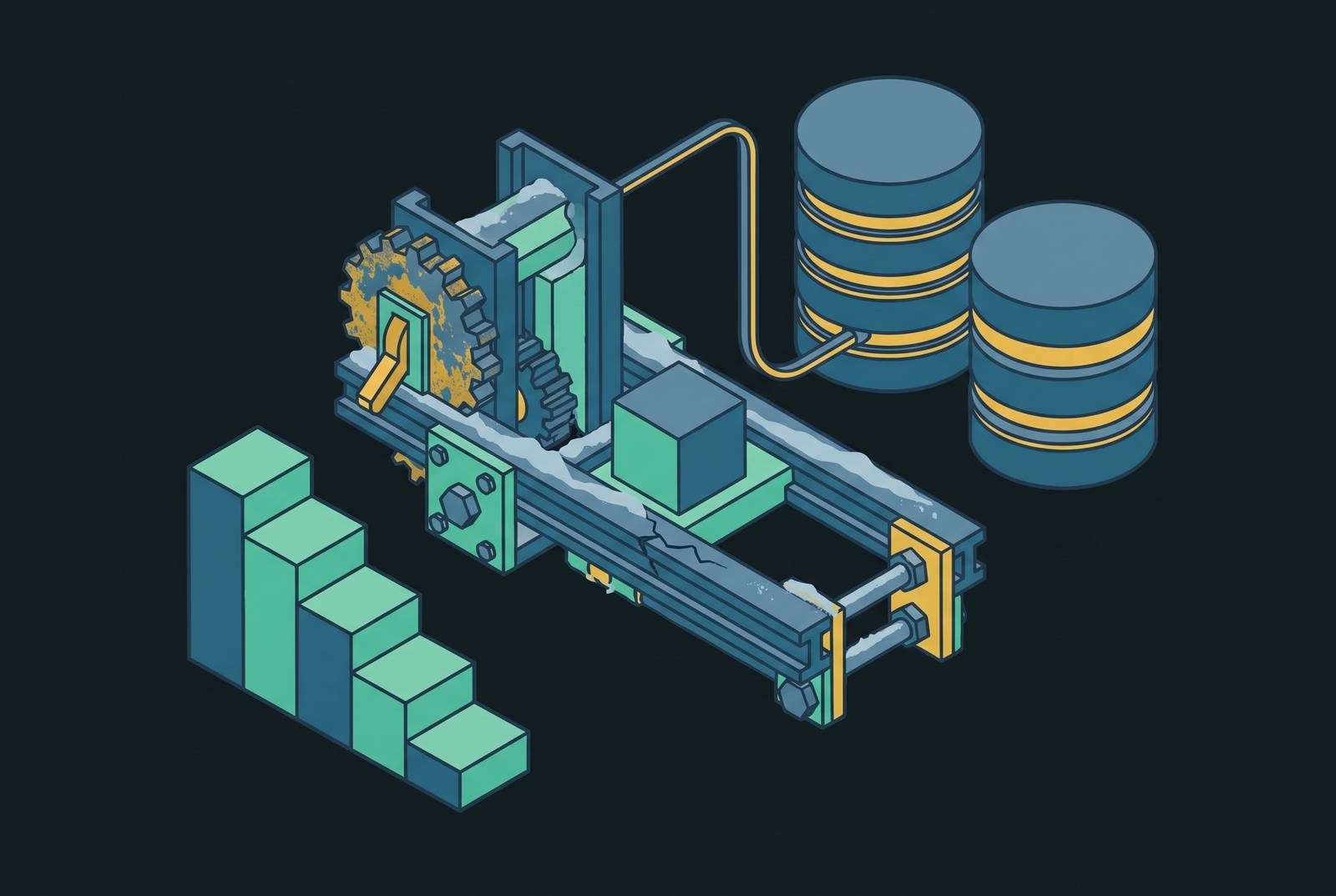
Most production agent failures trace back to the harness, the infrastructure wrapping the model, rather than to any deficiency in the model itself. As tasks grow longer and more complex, execution reliability depends on that infrastructure layer, not on the model's raw capabilities, and the April 2026 survey on agent harnesses states this as the binding constraint on reliability.
The Codex team's own field report puts the claim in concrete terms. Early progress on the project was slower than expected "not because Codex was incapable, but because the environment was underspecified". That sentence, from a team building one of the more scrutinized coding agents in production, names the actual site of failure: the scaffolding around the model.
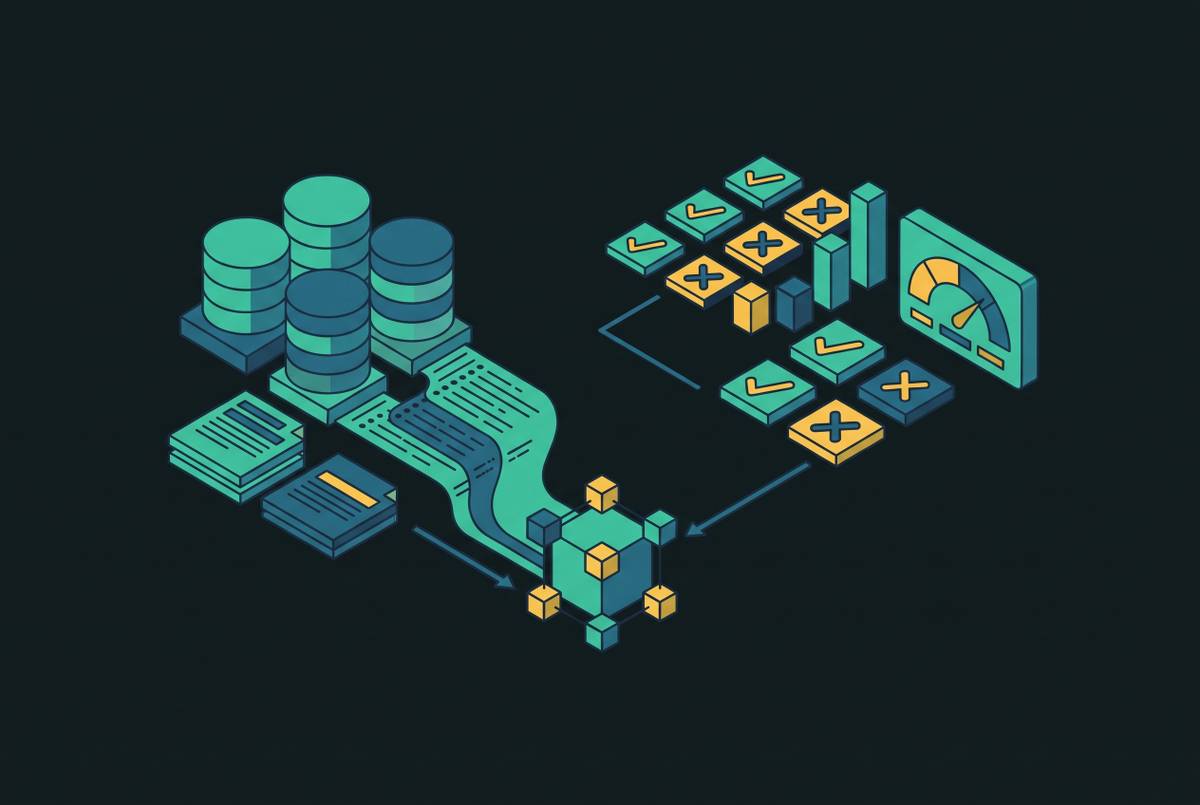
The three-tier failure taxonomy gives this claim a number. Data and context layer failures make up roughly 55% of enterprise harness failures, and that layer can fail without throwing a single exception. It produces plausible-sounding wrong answers instead of errors, and the absence of a stack trace or a failed health check leads teams to debug the model, swap in a newer version, retune a prompt, when the actual defect sits in the data and context the harness is feeding in. Diagnosing in the wrong place costs time and, worse, trains teams to distrust models that are performing exactly as designed on the inputs they are actually receiving.
None of this is an argument that models are flawless or that model selection never matters. It is an argument about where engineering attention should go first when a production agent starts producing bad output. The harness, not the model, is where the majority of enterprise-scale failures originate, and that fact alone should reorder how incident response teams triage.
What harness staleness is
Within harness failures, one category behaves differently from the rest: staleness, a correctness drift that occurs when the live environment moves while the harness stays fixed. A harness is a system that can be correct on the day it ships and incorrect months later, without a single line of its own code changing.
This distinguishes staleness from the other defects catalogued in the three-tier taxonomy, things like mega-prompts, invisible state, or all-or-nothing autonomy design. Those are design defects baked in at authoring time, flaws present from the first run. Staleness works differently: the harness was correct when written and becomes wrong as the world around it changes. A system prompt that accurately describes product behavior at one point in time can misdescribe it later because the product moved and the prompt didn't.
Martin Fowler's synthesis of harness engineering practice names "entropy management," the periodic repair of documentation drift, as one of three interlocking systems that define the discipline. That inclusion is itself an acknowledgment that harness correctness is not a one-time achievement. It decays on its own, continuously, without active maintenance, and that is a different engineering problem than catching bugs before deployment.
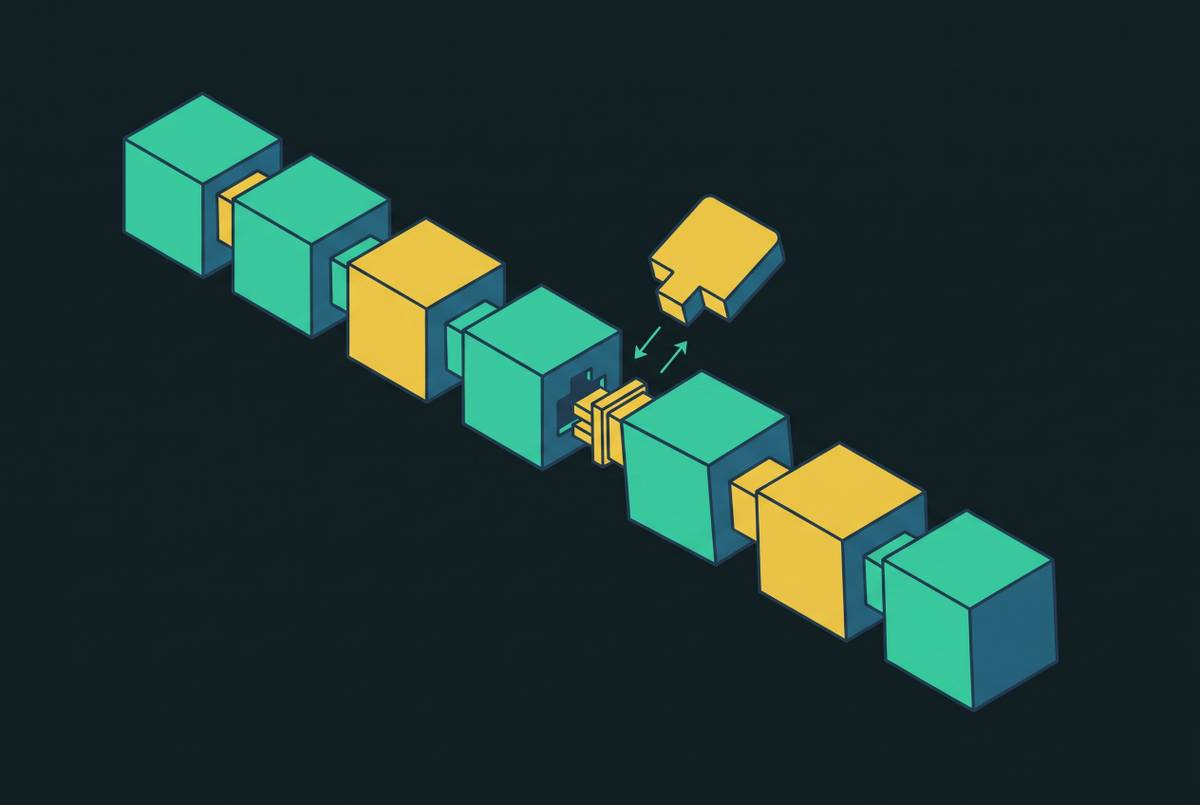
Staleness enters through four independent channels, one for each function a harness performs: prompts drift from product logic, tool schemas drift from API state, memory drifts from factual reality, and workflow definitions drift from process state. Each channel degrades on its own schedule and can compound with the others. The category is dangerous in production because staleness degrades output quality without throwing errors, so the system looks exactly like a model that has quietly gotten worse, when the model has not changed.
How each harness layer goes stale
Each of the four harness layers has its own characteristic way of going stale, and the failure signatures at each layer are distinct enough to support real attribution, once an engineer knows what to look for.
Prompt staleness
System prompts encode assumptions about product behavior, user intent, and business rules, and those assumptions get old. A prompt written against one product state becomes misleading as the product evolves around it, and the mega-prompt anti-pattern makes this worse: when all behavior is encoded in a single monolithic block of instructions, a stale directive gets buried inside thousands of words, leaving the agent with no way to resolve a conflict between outdated guidance and current reality.
Anthropic's April 2026 postmortem on a Claude Code quality regression traced one contributing cause directly to this mechanism: an overly aggressive verbosity-limiting system prompt that had been reasonable when written became a source of regression as the task environment shifted around it. The failure signature to watch for is specific: output quality degrades on one class of tasks while the model performs normally on everything else, and the degraded class lines up precisely with the domain the stale instruction was meant to govern.
Tool schema drift
Tool schemas function as the interface contract for the capability registry. When an external API changes its parameters, its response shape, or its authentication model, the registered schema becomes wrong without the harness itself changing at all.
The n8n incident from February 2026 shows how this plays out. Upgrading from v2.4.7 to v2.6.3 introduced silent schema drift that caused the agent to generate invalid JSON in tool calls, breaking both OpenAI and Anthropic integrations at the same time. The agent kept running, with no crash, but it produced calls that could never succeed. Schema drift is dangerous because it disguises itself as a model error: the agent emits a syntactically plausible but semantically invalid tool call, and without schema-aware instrumentation the resulting log reads exactly like a hallucinated argument, not an outdated contract.
Tool bloat accelerates the same problem. Vercel's engineering team found that if you cut your agent's available tool set by roughly four-fifths, task completion improves, and degradation tends to set in around twenty registered tools. A large, stale registry gives you more failure surface than a small, current one does. Tool call failures cluster around a specific tool or API version boundary, and they begin sharply at a deployment or dependency update date rather than accumulating gradually.
Memory staleness
In-context memory accumulates facts, constraints, and guidance across a session, and as sessions grow, compaction and summarization discard or distort earlier content. The invisible-state anti-pattern names the underlying mechanism: the agent relies on the model's context window to carry state, but context windows are finite and the model has no reliable memory across turns, so state degrades as context grows and nothing announces the degradation.
The research brief identifies three distinct, quantifiable failure modes inside this process: capacity overflow, substantial fact destruction during compaction, and behavioral drift from constraint erosion across cascaded summarizations. Any single one of these leaves the memory layer holding a picture of the operating environment that no longer matches reality. The resulting failures are episodic rather than constant: an agent contradicts a decision it made earlier in the same session, or violates a constraint it explicitly acknowledged a few turns before, with failures correlating to session length and to compaction events rather than to any particular input.
Workflow definition staleness
Workflow and routing definitions encode assumptions about which steps execute, in what order, and under which conditions. When the underlying business process changes, the workflow definition remains a map of a territory that no longer exists. Workflow loops, agents stuck cycling through reasoning and tool calls that look active in the logs but produce no forward progress, are the clearest signature of this failure: the workflow has no valid exit path for the current state of the environment because its branch conditions were written for a different one.
Most agent incidents come from tool-call failures, context truncation, and runaway loops rather than from model errors, but standard APM tools can't see any of these unless you build agent-aware instrumentation to trace them. That makes stale workflow logic invisible to conventional monitoring by default, not as a gap teams have failed to close but as a structural blind spot in the tools most teams already have running.
Why staleness compounds across layers and across agent boundaries
Harness staleness does not add across layers. It multiplies, because a stale output from one layer becomes a corrupted input to the next layer's reasoning, and the resulting failure is harder to diagnose than the sum of its parts would suggest.
The Claude Code regression from April 2026 is the clearest demonstration on record. Three independent harness changes occurred at once: a reasoning-effort parameter downgrade, a caching bug that continuously dropped thinking history from stale sessions on every turn, and the overly aggressive verbosity-limiting system prompt already described above. Each change was marginal on its own, small enough that it might not have triggered an alert in isolation. Combined, they produced a visible quality regression that took a rigorous postmortem to untangle, because no single change was large enough to point to on its own and the interaction between them was the actual cause.
The same compounding logic extends across agent boundaries in multi-agent systems. MAS-FIRE demonstrates that semantic failures, hallucinations, misinterpreted instructions, reasoning drift, propagate silently from one agent to another without raising a runtime exception anywhere in the chain. A downstream agent fails for reasons invisible from inside its own harness, because the cause originated upstream, in a different agent's context. Attributing a failure requires cross-agent trace correlation built in advance, because by the time the failure surfaces, the originating drift may be several hops removed from where you observe it.
This has a direct consequence for how teams should think about remediation, well before remediation is the topic at hand. Fixing one stale component in isolation produces diminishing returns if the others are left untouched: correcting a stale tool schema while the system prompt remains stale still produces failures, just with a different proximate cause attached to them. Staleness has to be treated as a property of the whole harness, not localized to whichever layer happened to surface first.
Why standard monitoring misses harness staleness
Conventional monitoring only catches harness staleness after it has already degraded what the user sees, because the signals it produces look like normal operation until accumulated drift crosses a visible threshold. The defining property of staleness is that it produces no errors, so error-rate dashboards, latency alerts, and standard APM tooling register nothing unusual at all. The agent is running, it is calling tools, it is returning outputs. Those outputs are just increasingly wrong, and nothing in a conventional dashboard distinguishes a wrong output from a right one.
For the data and context layer, the three-tier taxonomy is explicit: no exception is thrown, the agent returns a plausible-sounding wrong answer, and the failure passes downstream until a human happens to catch it. Teams typically spend real time debugging prompt design or reconsidering model selection before anyone discovers that the harness was feeding stale context the entire time. Workflow loops follow the same pattern from a different angle: the agent appears active in the logs, producing tokens and making tool calls, but the calls are cycling rather than progressing, and latency grows with no accompanying error signal to flag it. If you haven't built agent-aware instrumentation to detect cycling, this looks like a slow but healthy agent rather than a stuck one.
Even automated attribution tools, built specifically to solve this problem, have a real ceiling. AgentDebugX, evaluated on the Who&When benchmark, found that DeepDebug, the strongest performer in its 2026 analysis, achieves 28.8% strict agent-and-exact-step accuracy. The best available automated root-cause localization tool gets the right answer less than a third of the time, so human review has to stay part of the process, not fade out as tooling improves. Observability without evals produces a dashboard that shows a healthy-looking agent producing degraded outputs, since nothing in the trace says the output is wrong. Evals without observability produce benchmark scores that describe a system no longer running in production, disconnected from whatever the live harness is actually doing. Both are needed together, and neither substitutes for the other.
Layer-specific detection methods that catch staleness before it reaches output quality
You need instrumentation built for each layer specifically to catch staleness before it degrades output, because each layer's drift leaves a different signal at a different point in the execution trace, and a generic observability layer bolted on after the fact will miss most of them.
For prompt staleness, you need to track output quality by task category rather than in aggregate, because the Claude Code case shows the degradation concentrating in the specific domain a stale instruction governs rather than spreading evenly across all tasks. A dashboard that only reports an overall success rate will dilute a sharp, localized regression into a flat, unremarkable trend line.
Tool schema drift calls for monitoring tool call validity against the live API contract, not just against the harness's own recorded schema, and for watching failure timing specifically: a sharp failure spike that begins at a deployment or dependency update date is the signature the n8n incident left behind, distinct from the slow degradation that other defects produce. You also need to track registry size alongside task completion here, because Vercel's team found a threshold effect around twenty tools, so a growing, aging tool set is itself a leading indicator you should watch before any individual schema breaks.
Memory staleness calls for instrumentation around compaction events themselves, not just around session outcomes, since the three failure modes identified in the research brief (capacity overflow, fact destruction during compaction, and constraint erosion across cascaded summarizations) each occur at a specific, identifiable point in a session rather than gradually across its full length. Detecting a contradiction between an agent's current output and a constraint it acknowledged earlier in the same session is a direct, checkable signal that compaction has already discarded something load-bearing.
Workflow staleness calls for instrumentation that distinguishes active token generation from actual task progress, since standard APM cannot make that distinction on its own. A workflow trace that tracks state transitions, not just tool calls, can surface a cycling pattern well before latency alone makes the stall obvious to a human watching a dashboard.
Across all four layers, the underlying requirement is the same: detection has to be built around the specific place each layer's drift enters the system, because a model producing a wrong answer and a harness feeding that model stale material look identical from the outside, and only layer-specific instrumentation can tell them apart.
Sources
- GitHub - ai-boost/awesome-harness-engineering: Awesome list for AI agent harness engineering: tools, patterns, evals, memory, MCP, permissions, observability, and orchestration. · GitHub
- (PDF) Agent Harness for Large Language Model Agents: A Survey
- AI Agent Harness Failures: 13 Anti-Patterns and Root Causes
- Memory as Infrastructure: Reliability Engineering for Persistent Agent Memory in Months-Long LLM-Assisted Development