Closed-Loop Agent Improvement Pipeline Design
Attribute failures to their layer, then fix only what broke.
A closed loop agent improvement pipeline is only as good as the signal it closes around, and most teams are closing the loop around the wrong one. The fix isn't complicated, though it is exacting: attribute the failure to its layer, generate a candidate scoped to that layer, and validate the candidate against a recorded production failure before anything ships. Skipping the first step makes the other two just motion.
Why a "ship and observe" workflow fails in production
The instinct behind "ship and observe" is understandable. Watch the system in production, notice when something breaks, patch it, move on. Most teams operate this way, and the approach is structurally broken, because observation without attribution tells you that something went wrong, not where in the system it went wrong or why.
Consider a refund agent that issued a refund it should never have approved. The trace showed no exception and no schema violation. Every tool call executed cleanly. Verification should have run before the refund tool fired, but instead the refund fired first. Tracing back through the prompt, the cause turned out to be a set of empathy clauses added to make the agent sound less robotic under distressed customer language. Under emotionally loaded input, those clauses quietly outweighed the verification clauses meant to gate the transaction. Nothing crashed, nothing threw an error. The agent just ran the steps in the wrong order because the prompt, under a specific emotional register, told it to.
The eval suite had passed at 100% in staging. Every test case the team had written, the agent handled correctly. The failure appeared only at the intersection of rare phrasing and real emotional intensity, a distribution that a static test suite, written by engineers guessing at what customers might say, never reproduced. Sequence bugs tied to tone or to rare input combinations occur only when the system meets input it wasn't built against, and no synthetic test set assembled ahead of deployment can promise that kind of coverage.
Production traces as the primary signal
Monitoring and observability get used interchangeably, and that habit causes real damage. Monitoring watches outputs: did the call succeed, did latency spike, did the response look reasonable. Agent observability makes a different claim entirely, it explains the chain of decisions that produced the outcome, and for a multi-step agent, prompt logs and token counts don't get you there. You need the reasoning path itself.
A production trace, done properly, contains the LLM calls, the tool calls, the routing decisions, the intermediate state the agent held at each step, and the full decision path from the user's request to the final response. That's the object the loop is built around. Not the transcript. Not the score. The trace itself.
The case for treating traces as the primary signal isn't sentimental, it comes down to honesty of distribution. Production traces carry the input mix a system actually sees, including the sentiment-loaded messages, the adversarial phrasing, and the tool API drift that only appears at scale. Synthetic benchmarks, however carefully built, come from people trying to imagine failure ahead of time. Production traffic just happens, at a scale and variety no bench test replicates.
Which makes the current state of the industry a real problem. As of early 2026, only about 15% of GenAI deployments instrument observability at all https://www.getmaxim.ai/articles/best-ai-observability-tools-in-2026-a-buyers-guide-for-production-teams/. The overwhelming majority of agent deployments running today have no structured access to the signal a closed loop depends on. They're guessing at whether a fix worked, and calling the guess a fix.
Stage one: attributing a failure to its specific layer before touching anything
Knowing a run failed doesn't tell you much. Knowing which layer caused it tells you almost everything, because a prompt ambiguity, a tool schema mismatch, a workflow sequencing error, a memory retrieval failure, and a genuine model limitation each call for a completely different repair. Attribution is the discipline of figuring out which one you're actually looking at before you touch anything.
That turns out to be harder than it sounds, especially when an LLM is doing the diagnosis itself. As execution logs get longer and more distributed across steps, the model doing the judging tends to anchor on the first plausible-looking cause rather than working through the full evidence. Call it premature closure: the judge spots a tool call that looks wrong, declares that the culprit, and stops looking, even when the actual fault sits two steps upstream in a planning decision.
One approach that counters this decomposes the agent into modules, memory, reflection, planning, and action, and attributes each failure to its root module before any corrective step gets proposed. That forces the diagnosis to actually name where in the pipeline the breakdown occurred, instead of settling for "the agent got it wrong."
A more systematic effort along these lines is the MAST taxonomy, validated against more than 1,600 execution traces and presented at NeurIPS 2025. It maps 14 distinct failure modes into three root categories: system design issues, inter-agent misalignment, and task verification. The finding that should reshape how teams spend their debugging effort: system design issues and inter-agent misalignment together account for 79% of production breakdowns in multi-agent systems. Task verification, the category most teams instinctively reach for when a multi-agent system fails, turns out to be the smaller slice. Most of what breaks, breaks upstream of verification, in how the system was designed or how its agents coordinate with each other.
Stage two: generating candidate fixes that are scoped to the attributed layer
Once the layer is known, the fix has to stay inside it. This stage looks more like engineering than diagnosis: prompts, tool schemas, workflow sequencing, memory retrieval, and orchestration logic are all levers that move without retraining the underlying model. That's the entire harness, and it's the primary surface where interventions actually happen.
Scoping isn't a nicety, it's the whole reason attribution has to come first. A fix aimed at the wrong layer does one of two things: nothing, because it never touches the real cause, or it masks the failure temporarily while quietly planting a second problem elsewhere in the system. Skipping attribution and jumping straight to a fix is how teams end up patching symptoms forever, never quite reaching the disease.
At the prompt layer specifically, a family of optimization methods exists for exactly this task. OPRO, ProTeGi, TextGrad, and GEPA all rewrite instructions, demonstrations, or templates without touching model weights at all. GEPA in particular evolves prompts through trajectory reflection over a Pareto pool, running a structured search over prompt variants and keeping the ones that dominate on multiple failure dimensions rather than just one.
The refund agent case closes with a specific number. A single ProTeGi pass, run against the exact failure subset identified during attribution, took function_call_accuracy from a 62% baseline to 96% https://futureagi.com/blog/self-improving-ai-agent-pipeline/. No model swap, no fine-tuning run, no architecture change. Just a system prompt rewritten against the specific sequence failure attribution had already isolated.
Stage three: replay validation, why candidates must be tested against recorded production failures before shipping
A fixed prompt that looks good isn't the same as a fixed prompt proven against the failure it's meant to fix, and this is where most teams quietly cut corners. The obstacle is reproducibility. LLM responses are non-deterministic by construction: a given failure depended on a specific inference pass that won't repeat bit for bit, on tool calls that read state which has since changed, and on a multi-step trajectory a fresh run is unlikely to retrace exactly. Re-running the same input twice doesn't guarantee the same failure twice. Trying it again and seeing if it still breaks isn't a validation method, but it's a coin flip dressed up as due diligence.
Existing tooling doesn't close this gap on its own. Tracing tells you what happened. Evaluation frameworks score whether an output looks acceptable. Neither one lets an engineer swap out a single component of a recorded run, hold everything else fixed, and check whether the fix actually resolves the failure. That capability sits in the gap between the two categories of tooling most teams already own.
Cut-point replay, as implemented in Chronicle, is built to close exactly that gap. It records agent runs at their non-deterministic boundaries, points like a model call or a tool invocation, as immutable envelopes. Its core operation then takes a chosen subset of those recorded boundaries and replays them exactly as recorded, while executing the remaining subset live against new code. That turns a single recorded incident into something close to a regression test: it runs in CI, it isolates the change under test, and it holds the rest of the trajectory fixed so the comparison stays fair.
The performance numbers matter because they show this is practical at scale. Recording overhead runs at 23 microseconds, negligible against typical agent latency. Full replay, run without the live component, issues zero model calls and stays bit-stable across 20 repetitions, which is the property that makes it usable as an actual regression gate rather than a flaky check someone eventually starts ignoring. Across all 6 recorded incidents in benchmark testing, cut-point tests failed reliably on faulty code and passed on both guarded fixes and benign changes, which is exactly the behavior wanted from a regression suite: it catches the real problem and doesn't cry wolf on changes that shouldn't fail.
Hallucinated correctness undermines validation even when everything above is in place. A judge scoring a candidate's final answer can be fooled by an output that sounds right without ever checking that the underlying tool-call sequence was correct. Scoring the answer isn't the same operation as verifying the execution path that produced it, and conflating the two is how a broken sequence slips through a review that only ever looked at the final message.
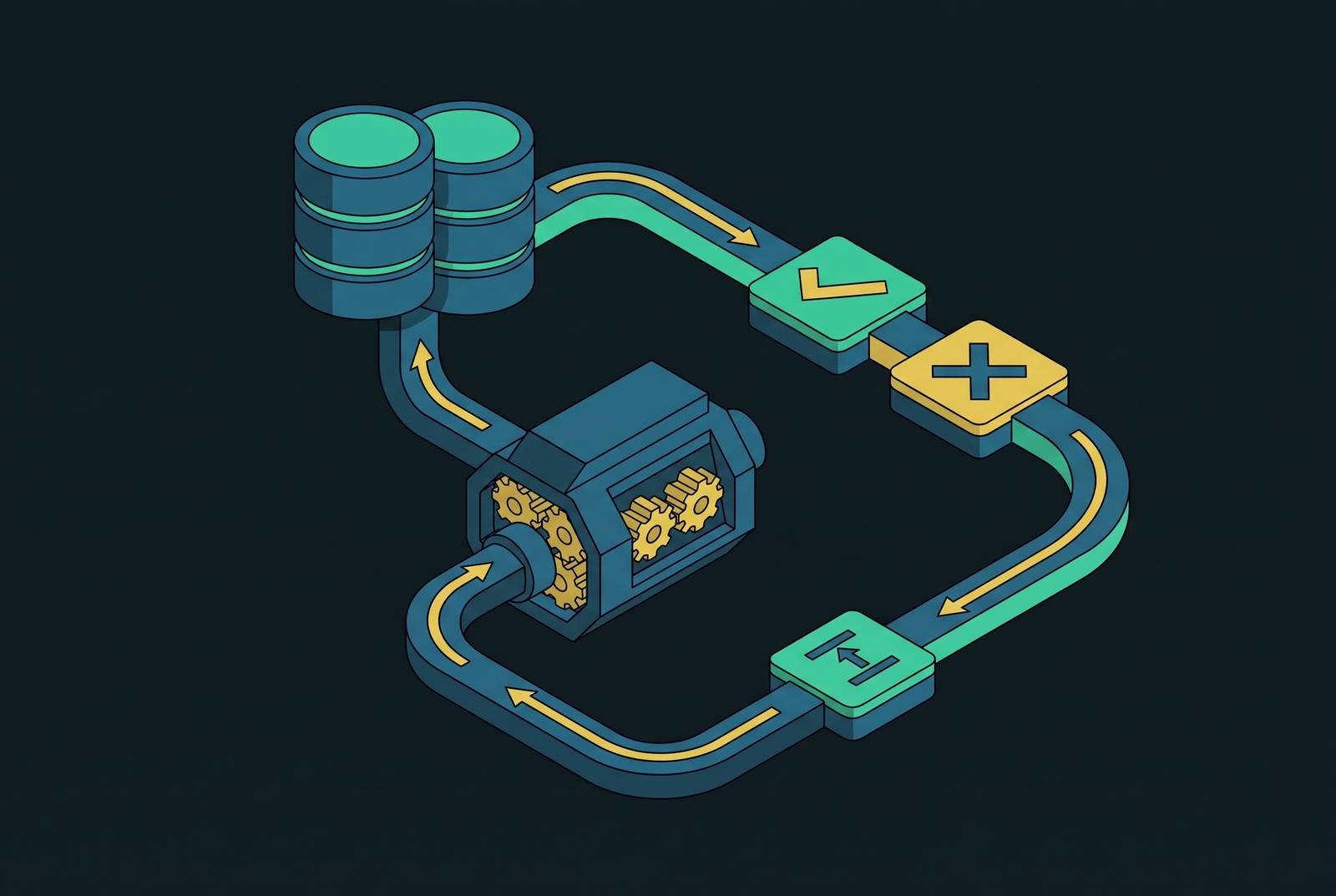
The four stages connect into a loop that tightens over time.
Each stage in this pipeline hands the next one structured data. Traces feed attribution. Attribution scopes the candidates that stage two is allowed to generate. Whatever passes gets shipped, and shipping generates new traces, which restarts the cycle. That handoff is the actual mechanism, not a metaphor, and it's what "closed loop" means in concrete terms.
What keeps this from turning into a treadmill, chasing its own tail forever, is that the failure set genuinely shrinks. Each fix that survives replay validation removes a specific failure mode from the pool. The next iteration isn't starting from zero, it's working against a narrower, more specific remainder. That's convergence, not repetition, and it's the property separating a real improvement loop from a team that just keeps making changes and hoping something sticks.
New production traffic, running against the newly shipped fix, becomes the observation input for the next cycle. Fixes introduce their own failures sometimes: a prompt rewrite that solves the sequencing bug might open a new edge case somewhere else in the flow. The loop catches that in its next attribution pass instead of letting it pile up silently in a system nobody's watching closely anymore.
None of this requires the underlying model to change. The agent's model stays what it was. The harness wrapped around it, including the prompts, the schemas, and the sequencing logic, improves on a schedule and by design. That's a meaningfully different claim than "the AI is getting smarter." This is an engineering discipline applied to a fixed model, not an emergent property of the model itself. It's repeatable because it's mechanical, and it's auditable because every stage leaves a record behind.
Observability platform choices that affect what the loop can do
The platform layer isn't a footnote here, it decides which parts of the loop can even get built. A Gartner forecast found that 60% of software engineering teams are expected to use AI evaluation and observability platforms by 2028, up from 18% in 2025, a tripling in three years https://www.getmaxim.ai/articles/best-ai-observability-tools-in-2026-a-buyers-guide-for-production-teams/. Infrastructure decisions made now are going to be much harder to unwind once that adoption curve plays out.
The market is consolidating at the same time, and quickly. ClickHouse acquired Langfuse in January 2026, Braintrust raised an $80M Series B in February 2026, and the direction is toward fewer, deeper platforms rather than a long tail of point solutions. The LLM observability platform market was valued at roughly $1.97B in 2025 and is projected to reach $2.69B in 2026, which tells you how much capital is chasing this specific problem right now https://www.digitalapplied.com/blog/ai-agent-observability-2026-tracing-monitoring-stack-guide.
Given that, the functional test for any platform should map directly onto what the loop actually needs. Does it capture the full decision path? Can traces convert into evaluation cases without a rebuild? Does it support replay or cut-point testing, or something functionally close to it? Does it feed production failures back into the improvement pipeline automatically, or does someone have to stitch that by hand every time? Those aren't abstract preferences, they're the literal requirements the closed loop imposes on whatever platform runs underneath it.
MLflow sits apart from most of the field on this test. It's the most widely adopted open-source AI engineering platform, and it covers observability, evaluation, prompt optimization, and governance inside one system rather than forcing teams to stitch separate tools together. Available comparisons also show it's the only tool combining open-source licensing with deep agent tracing and replay, prompt versioning, and automated evaluation in a single platform, without an enterprise paywall gating the deeper functionality. For teams that want to own their trace data outright rather than rent access to it, that combination stands as a serious alternative to the faster-moving, more consolidated commercial platforms now raising large rounds and getting acquired around them. Continual Search raises GPT-5.5's Weighted F1 from 0.451 under Passive Continuation on the TRAIL benchmark (Continual Search, https://arxiv.org/pdf/2609.13463).